Your Supplier's Green Claim Is Now Your Claim: What Proof to Ask For
Very few green claims in an online shop are written from scratch. The product description comes from the brand's data sheet. 'Made with recycled polyester' comes from the fabric mill. 'Compostable mailer' comes from the packaging supplier. 'This website runs on green energy' comes from the hosting provider's badge. The shop copies them in good faith, often word for word.
Under the Unfair Commercial Practices Directive, as amended by EmpCo, the business that makes a commercial communication to consumers is responsible for it. Once a supplier's sentence is on your product page, in your feed or in your newsletter, it is your advertising, whoever wrote it first. Since 27 September 2026, that includes the new prohibitions: a generic claim, a self-made label or an offset-based neutrality claim does not become acceptable because a supplier supplied it.
Do not publish a supplier's environmental claim until you hold the evidence for it yourself. 'The supplier said so' explains how the claim got there; it does not make it lawful.
What to ask for, claim by claim
The evidence depends on what the claim says. The table below covers the claims we see most often on supplier material. In every case, check that the evidence covers the exact product, the exact part of it and the period you are selling in.
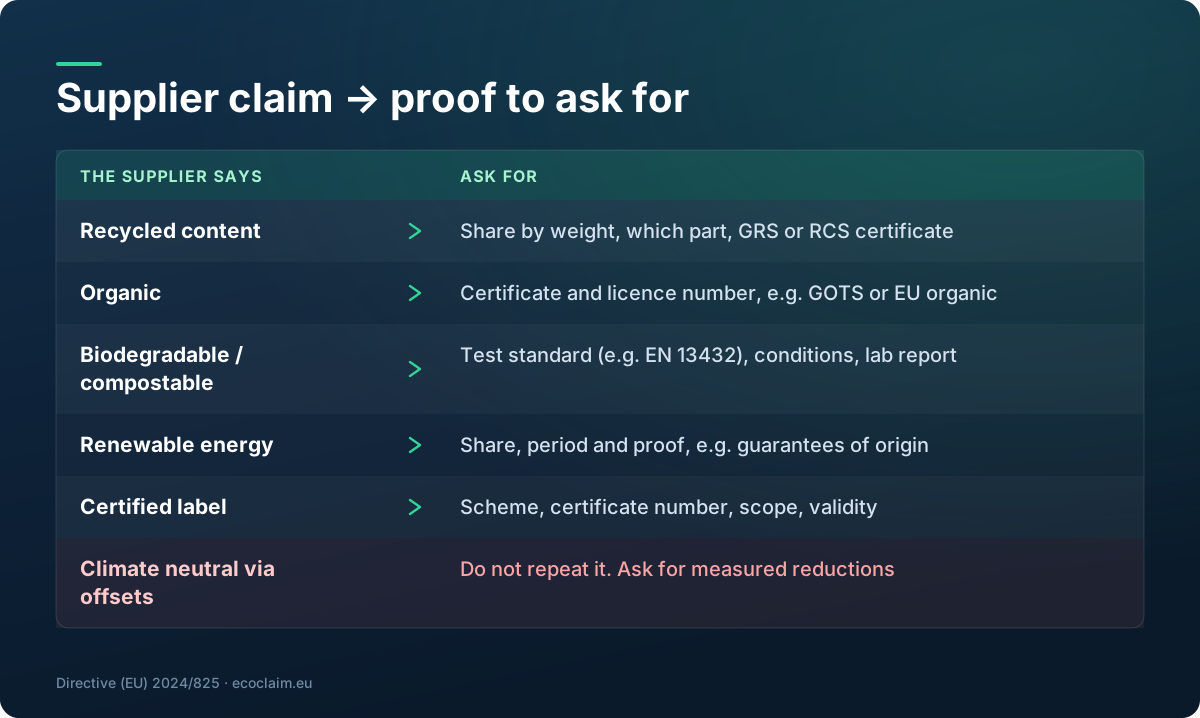
Recycled content. Ask for the share by weight, which part of the product it applies to, and a chain-of-custody certificate such as the Global Recycled Standard (GRS) or the Recycled Claim Standard (RCS), ideally with the transaction certificate for your batch. Then write the claim the way the evidence reads: 'outer fabric 70% recycled polyester (GRS)', not 'made from recycled materials'.
Organic. Ask for the certificate of the scheme that applies, for example GOTS for textiles or EU organic certification for food, with the licence or certificate number and the product scope. A supplier's own 'organic line' without certification is not enough, and the word on its own is restricted.
Biodegradable and compostable. Ask which test standard was used (EN 13432 is the usual one for compostable packaging), under which conditions (industrial composting is not the same as a garden compost heap), and for the test report from the laboratory. Write the conditions into the claim: 'compostable in industrial facilities (EN 13432)'.
Certified labels. Ask for the scheme name, the certificate number, what it covers and until when. Then check the certificate in the scheme's public database where one exists. A logo on a supplier's sheet is not proof that your product is certified.
Future targets. If a supplier claims 'net zero by 2030', you can only repeat it if a detailed implementation plan with measurable targets exists and is checked by an independent expert. If they cannot show you that, do not repeat the target.
Claims you should not repeat at all
Some supplier claims cannot be fixed with a better document. Neutrality based on offsetting ('climate-neutral product', 'CO₂-compensated delivery') is prohibited outright since 27 September when it rests on purchased offsets (Annex I, point 4c). Self-made sustainability labels, a supplier's own badge without a certification scheme or public authority behind it, are prohibited too (Annex I, point 2a). And generic words ('eco', 'green', 'sustainable') stay prohibited unless the specific fact is given or recognised excellent environmental performance stands behind them (Annex I, point 4a). For these, ask what the supplier actually measured or certified, and write that instead.
A common example: green hosting badges
Many shops show a 'green hosting' or 'this website runs on renewable energy' badge in the footer, supplied by their hosting provider. It is an environmental claim like any other, and it sits on every page of the shop. Before you display it, ask the provider: what share of the energy is renewable, how it is proven (for example guarantees of origin or a green electricity contract), for which data centre and which period, and whether any 'climate neutral' or 'carbon negative' part of the claim rests on offsets. If it does, that part has to go.

Hosting providers that take the question seriously publish their answers. The Spanish provider Replanta, for example, has written up seven questions a business should ask its hosting provider (in Spanish), written for sustainability reporting but just as useful before you put a badge on your site. Whatever the provider, the test is the same: the badge may only say what the documents show.
Keep a supplier claim register
The practical tool is a simple table, one row per claim you publish: the exact wording, where it appears (product, page, feed, packaging), which supplier it comes from, the evidence document, its validity date, and who checked it when. It takes an afternoon to set up for a mid-sized catalogue and turns an awkward question from a competitor, an association or an authority into a five-minute answer.
- Ask at onboarding. Make the evidence part of listing a new product: no document, no claim on the page.
- Put it in the contract. Ask suppliers to confirm their claims are substantiated and to tell you when certificates lapse or products change. Your lawyer can advise on warranties and indemnities.
- Set renewal dates. Certificates expire. A claim that was true last year can be unsupported this year.
- Check before publishing. Paste supplier texts into the copy checker before they go live, and run a website check or a Site Sweep over the catalogue to find the ones already online.
The full set of checks for the rest of the shop is in our EmpCo checklist, and our routine for checking product texts shows how to turn a supplier's adjective into a fact you can publish.
Check supplier texts before they go live
Paste a product description from a supplier and see which sentences break which rule, with a rewrite you can test. Free, no account needed for the first checks.
Check a textFAQ
Am I responsible for claims a brand puts in its product descriptions?
If you publish them, yes. The business that makes the commercial communication to consumers is responsible for it. Copying the brand's text onto your page makes it your advertising.
Is a supplier's written confirmation enough?
Not on its own. A confirmation that a claim is true is not the evidence for it. Ask for the certificate, test report or data behind it, and check that it covers your product.
Can I keep a 'climate neutral' claim if the supplier offsets its emissions?
No. Since 27 September 2026, claims that a product has a neutral, reduced or positive environmental impact based on offsetting are prohibited outright. Ask for measured reductions and write those instead.
What about a green hosting badge in my footer?
It is an environmental claim on every page. Keep it only if the provider can document what it says, such as the renewable share and how it is proven, and remove any part that rests on offsets.
How do I find supplier claims already on my site?
Run a website check for the key pages, or a Site Sweep for the whole catalogue. Findings are grouped by wording, so a sentence copied across hundreds of products shows up as one decision.
Free account
Keep your compliance work in one place
Scans you run while signed out disappear when you close the tab.
- Save every scan and come back to it later
- See whether your score improves after you fix things
- Store certificates against the claims they prove