EmpCo Checklist for Online Shops: 12 Checks Since 27 September 2026

Since 27 September 2026, the rules of Directive (EU) 2024/825, known as EmpCo or ECGT, apply to every environmental claim a business makes to consumers in the EU. In Germany they sit in the Act against Unfair Competition (UWG); in every other member state in its own national law. There is no grace period for what is on your website today: a product page published in 2023 is judged by the same rules as one published this morning.
This checklist is for the people who run an online shop: the owner, the person writing product texts, the agency looking after the store. It has twelve checks, grouped by where the risk actually sits. Each one names the rule behind it, so you can explain a change to a colleague, a supplier or your lawyer.
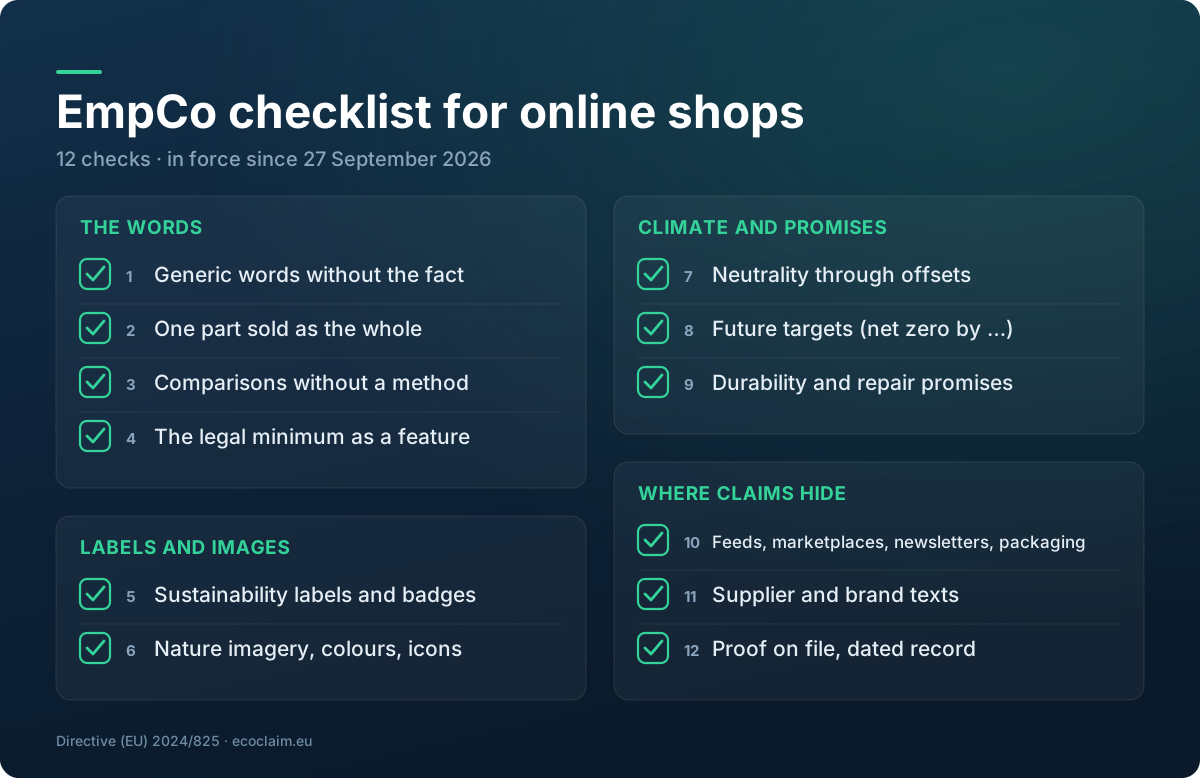
The words: checks 1 to 4
1. Generic words without the fact behind them. 'Eco-friendly', 'green', 'sustainable', 'climate-friendly', 'natural' on their own are generic environmental claims. Since 27 September they are prohibited unless you can show recognised excellent environmental performance, which in practice means an EU Ecolabel or a comparable official scheme (Annex I, point 4a). The fix is almost always the same: replace the adjective with the specific, provable fact, on the same page. 'Eco-friendly sneaker' becomes 'upper made of 80% recycled polyester'. Our banned words list has every restricted term with what to write instead.
2. One part sold as the whole. 'Recyclable packaging' when only the outer box is, 'made from recycled material' when only the lining is. A claim about the whole product or the whole business that is true only for one aspect is prohibited (Annex I, point 4b). Name the part: 'outer box recyclable with paper; inner bag not recyclable'.
3. Comparisons without a method. 'More sustainable than before', 'greener than conventional cotton'. A comparison on environmental characteristics now has to tell the consumer how the comparison was made, which products it covers and how current the data is (Article 7(7) of the Unfair Commercial Practices Directive, added by EmpCo). If you cannot say than what and measured how, take it out.
4. The legal minimum sold as a feature. 'Free from CFCs' on a spray can, 'phosphate-free' on a laundry detergent: both substances are already banned for those products by EU law. Presenting what the law requires of every product as something special about yours is prohibited (Annex I, point 10a). It is one of the quietest findings and one of the easiest to fix: delete it.
Labels and images: checks 5 and 6
5. Sustainability labels and badges. Every seal, badge or label that suggests environmental or social quality has to be based on a certification scheme with independent verification, or established by a public authority (Annex I, point 2a). Your own 'Green Choice' icon, a 'Planet Friendly' badge from your theme, a supplier's self-made seal: all of these fail. Recognised schemes such as the EU Ecolabel, GOTS, OEKO-TEX, FSC or the Blue Angel pass, provided the product is actually certified. Our three-question label test walks through it.
6. Images, colours and icons. Leaves, globes, green gradients and forest backdrops can create an environmental claim on their own, judged by the overall impression on the average consumer (Article 6(1) UCPD). A leaf icon next to a plastic product suggests a benefit that is not there. Images do not need to be removed by default, but each one that implies an environmental benefit needs the fact behind it, just like a sentence. Our image checker reads badges and pack shots the way a text check reads copy.
Climate and promises: checks 7 to 9
7. Neutrality based on offsetting. 'Climate-neutral shipping', 'CO₂-neutral product', 'carbon-compensated' are prohibited outright when they rest on purchased offsets (Annex I, point 4c). This is the one rule no amount of documentation fixes. What you can say instead is what you actually reduced, measured. Our post on twelve alternatives to 'carbon neutral' has wordings that work.
8. Future targets. 'Net zero by 2035', 'fully circular by 2030'. A claim about future environmental performance is only allowed with clear, publicly available commitments set out in a detailed and realistic implementation plan, with measurable, time-bound targets, verified regularly by an independent expert whose findings are available to consumers (Article 6(2)(d) UCPD). If that plan and verification do not exist yet, the target belongs in your internal strategy, not on the product page.
9. Durability, repair and update promises. 'Lasts a lifetime', 'built to last', 'repairable', 'long-life battery'. EmpCo added a set of prohibitions on durability and repair (Annex I, points 23d to 23i), including claims about durability under normal use that are not demonstrated, and presenting goods as repairable when they are not. Keep the claims you can back with test data, spare-part availability or warranty terms, and write those facts instead of the adjective.
Where claims hide: checks 10 to 12
10. Every channel, not only the shop pages. The rules apply to every commercial communication: product feeds for Google Shopping and marketplaces, Amazon and Zalando listings, newsletters and their templates, social posts that are still online, PDF catalogues, banners, and the packaging itself. A shop that fixes its product pages but keeps 'eco' in the feed title is still advertising with it. For packaging and stock that was already on the market before 27 September, Austria and Germany have special rules; our post on old stock explains what they cover and what they do not.
11. Supplier and brand texts. Retailers often paste the descriptions brands supply, word for word. Once a sentence is on your page, it is your advertising, whoever wrote it first. Ask for the proof before you publish the claim; our guide on what to ask suppliers for lists it claim by claim.
12. Proof on file and a dated record. For every specific claim you keep, file the evidence: the certificate with its number and validity, the test report, the calculation. Keep a dated record of what you checked and changed. In Germany, a warning letter from a competitor or an association is the most likely first contact with the new rules (our warning-letter guide explains the process), and a documented check is the strongest position to answer it from. Re-check after every range change, theme update or new supplier.
Start with checks 1 and 7: generic words and offset-based neutrality are the two most common top-severity findings across the sites we scan, and both are fixed in the text itself. Then labels (5), then the channels (10). Checks 8 and 9 tend to affect fewer pages but take longer, because the evidence has to exist first.
How to run the checklist on a real shop
- Find the claims. A free website check reads the key pages of your shop in about a minute and lists every flagged claim with the rule behind it. For the whole catalogue, a Site Sweep checks up to 1,000 pages in one go and groups the findings by wording, so 'eco-friendly' on 340 product pages is one decision, not 340.
- Decide per wording, not per page. For each flagged wording: keep with proof, rewrite to the specific fact, or delete.
- Rewrite and test. Paste the new text into the copy checker before it goes live.
- Fix the channels. Feeds, marketplace listings, newsletter templates, PDF catalogues.
- File the evidence and re-check. Keep the proof with the claim and scan again after the changes, so your record shows the before and after.
Start with the free check
See which of the twelve checks your shop trips today, with the rule behind every finding. No account needed for the first scan.
Check my siteFAQ
Is there a transition period for website texts?
No. The directive itself has no transition period, and the special rules Austria and Germany adopted for old stock concern goods and their packaging, not the texts on your website. Product pages, category texts, feeds and newsletters have had to comply since 27 September 2026.
Do the rules apply to small shops?
Yes. The prohibitions apply to every business that communicates with consumers in the EU, whatever its size. EmpCo has no exemption for small businesses.
Which check finds the most problems?
Check 1. Generic environmental claims are the most common finding across the sites we scan, followed by misleading imagery. Among the most serious findings, offset-based neutrality claims come second.
Can we keep a claim if we have a certificate?
Yes, if the certificate covers that product and that claim, is valid, and comes from a scheme with independent verification. Name the scheme and, ideally, the certificate number next to the claim.
How often should we run the checklist?
Once completely now, then after every change that adds text: new products, a new supplier, a theme update, a seasonal campaign. A short re-scan after each of those is enough to keep the record current.
Free account
Keep your compliance work in one place
Scans you run while signed out disappear when you close the tab.
- Save every scan and come back to it later
- See whether your score improves after you fix things
- Store certificates against the claims they prove