Amazon's Green-Claims Notice: What It Means and How to Fix Your Listings
Since mid-August 2026, Amazon sellers and vendors in the EU report receiving 'Action Required' notices about environmental claims on their product pages, often with a spreadsheet of affected ASINs. If one landed in your account, the deadline it names, 27 September 2026, has already passed, and listings that still carry the flagged claims can be deactivated.
The notice is not a new Amazon policy invented for the occasion. It applies the EU directive on empowering consumers for the green transition (EmpCo, also called ECGT), which has applied since 27 September 2026 to every commercial claim made to consumers in the EU, in your own shop and on a marketplace alike. This post explains what sellers report the notice contains, what the law actually bans, and how to clean a catalogue properly, which is more than the rows in the spreadsheet.
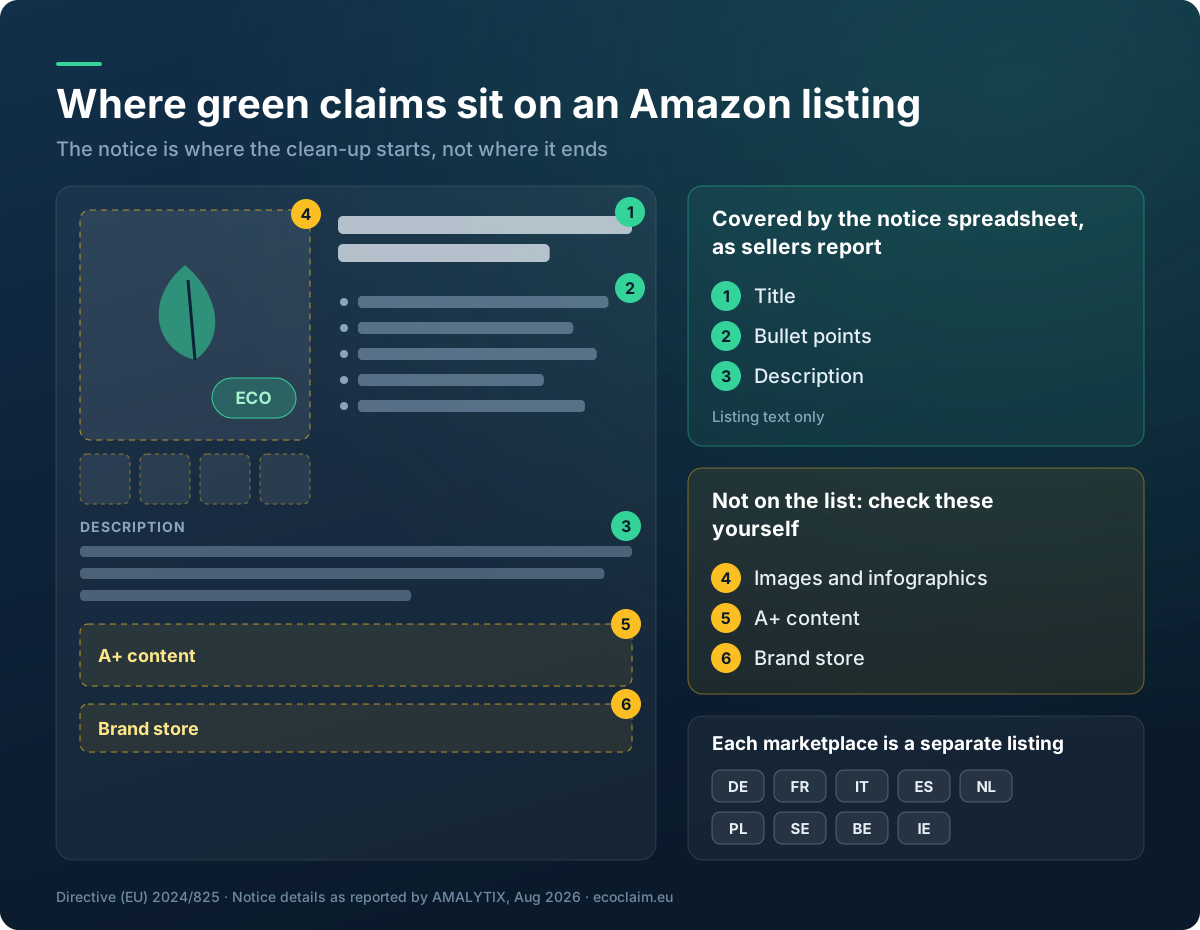
The ASIN list is where the clean-up starts, not where it ends. Sellers report that it covers listing text only. Images, infographics, A+ content, your brand store and every other EU marketplace still need checking, and the law applies to all of them whether Amazon flagged them or not.
What sellers are receiving
Amazon has not published the EU notice openly, so what we know comes from sellers and the tools they use. According to Amazon-tools provider AMALYTIX, the notices started in mid-August 2026, reached vendors first, and often come with an Excel file of ASINs. Affected products are reportedly marked 'ECGT' on the Product compliance page, together with a claim type such as 'generic green claims' or 'recyclability claims'.
Two deadlines are reported to run in parallel. Fifteen days after the first notice, Amazon may remove the whole section of the listing that contains the claim. From 27 September 2026, listings that still carry it can be deactivated. Examples Amazon reportedly gives include 'eco-friendly', 'environmentally friendly', 'sustainable materials', 'climate-neutral' and 'carbon-neutral', and the list is not exhaustive.
Amazon has done this before. In Australia it announced that from 21 October 2024 it would remove unqualified claims such as 'eco-friendly', 'sustainable' and 'green' from listings. The EU wave follows the same pattern, this time with a binding directive behind it.
What the law bans, and what it allows with proof
The rules are the same as for any website. Some claims are banned in all circumstances. Others may stay if you can prove them, and the proof has to match exactly what the claim says. Our list of banned words covers the wording in detail; for a listing, these are the cases that come up most.
- Generic claims such as 'eco-friendly', 'green', 'sustainable', 'climate-friendly' or 'environmentally friendly' are banned unless the product has recognised excellent environmental performance relevant to the claim, such as the EU Ecolabel.
- Neutrality based on offsetting ('climate-neutral', 'CO₂-neutral', 'net zero' resting on purchased credits) is banned outright, whatever certificate the offsets carry.
- Self-made badges. A sustainability seal you designed yourself, on an image or in A+ content, is banned. Only labels based on a certification scheme or set by a public authority are allowed.
- One part sold as the whole. 'Sustainable toothbrush' when only the handle is bamboo, or 'recycled packaging' presented as a claim about the product.
- A legal requirement presented as a feature, such as 'free from' a substance that is already banned in the EU for that product.
- Allowed with proof: specific, verifiable claims such as 'handle made of FSC-certified bamboo', 'carton made of 80% recycled fibre' or 'compostable in industrial facilities (EN 13432)', as long as you hold the evidence.
The clean-up checklist
Work through the catalogue in this order. The first step is what the notice asks for; the rest is what the notice leaves out.
- Every ASIN on the list, every text field. Title, bullet points and description. Remove banned claims, and rewrite the rest so they say something specific and true.
- Product names and brand names in titles. AMALYTIX reports that names containing 'Eco', 'Green' or 'Natural' can count as a claim if a shopper reads an environmental message into them.
- Images and infographics. Leaves, globes, 'eco' stickers, comparison graphics and badges on images two to seven. These are claims too, and the spreadsheet does not list them.
- A+ content and the brand store. Comparison tables and brand-story modules are where vague sustainability wording tends to survive a text clean-up.
- Every marketplace separately. A listing fixed on amazon.de is not fixed on amazon.fr, amazon.it or amazon.pl. Each has its own text in its own language.
- Products that are not on the list. The list is reported to be non-exhaustive, and the law does not depend on it. Check the rest of the catalogue with the same rules.
- New listings. Write them clean from the start, and add a claim only if the evidence is ready to upload with it.
- Packaging, as a second workstream. Claims printed on the box are also commercial communication, but fixing them takes longer than editing a listing. Do the listing first.

Images are where most sellers stop too early. A title can be rewritten in a minute; an infographic with 'eco' in a green circle has to go back to whoever made it. List every image with text on it, per marketplace, and check them in the same pass as the listing text.
What counts as proof
If you want to keep a claim, the evidence has to cover the exact product and the exact claim. A general eco-label does not support 'biodegradable' if biodegradability is not among its criteria.
- For generic claims: the EU Ecolabel, or an official ISO 14024 type I ecolabel recognised in the EU, such as the Blue Angel, the Nordic Swan, the Austrian Ecolabel or Milieukeur. Our post on the three label categories explains which labels count.
- For specific claims: test reports and data, for example EN 13432 for compostability, measured recycled content with a chain-of-custody certificate, or recognised energy-label data for energy claims.
- For durability or repair claims: test data or a recognised assessment method. 'Built to last' without evidence is not allowed.
- If you resell: ask the brand or manufacturer for the documents. Our post on supplier claims lists what to request for each type of claim. No document, no claim.
According to AMALYTIX, Amazon takes the evidence through the same compliance-document fields many sellers know from the product-safety (GPSR) process, separately for each marketplace, with a direct download link to the file.
Austria and Germany have special rules for goods that were already on the market before 27 September 2026. They concern the goods, not the text you can change today, and AMALYTIX reports that the EU's network of consumer authorities expects online claims to be updated. Our post on old stock explains what those rules cover.
An example: before and after
A made-up listing title of the kind that is common today: 'Bamboo toothbrush, pack of 4 – 100% eco-friendly and sustainable, biodegradable, climate-neutral shipping'.
- 'Eco-friendly' and 'sustainable' are generic claims without recognised excellent performance behind them.
- '100%' covers more than is true: the bristles are nylon.
- 'Biodegradable' says nothing about the conditions or the time it takes.
- 'Climate-neutral shipping' rests on offsetting, which is never allowed as a neutrality claim.
A safer version: 'Bamboo toothbrush, pack of 4 – bamboo handle, nylon bristles, packed in cardboard'. Specific, true and checkable. A certification belongs in the listing only if you hold it for this product.
How to check your listings quickly

Our page for Amazon sellers runs both checks in one place. Choose your marketplace, so the right country rules apply, then paste the title, bullet points and description of a listing. Each risky phrase is flagged with the rule it breaks and a safer rewrite. Upload your main image, infographics or A+ modules to check the text and green signals in them.
Work one marketplace at a time, copy the rewrites into Seller Central, and keep a note of what you changed and why. The first checks are free, without an account.
Check your Amazon listing
Paste your listing text or upload your images, choose the marketplace, and see what to fix, with a rewrite for each finding. Free, no account needed for the first checks.
Check your Amazon listingFAQ
I haven't received a notice. Do I still need to check my listings?
Yes. The law has applied to every listing aimed at EU consumers since 27 September 2026, whether or not Amazon flagged it. Sellers report that the ASIN list is not complete.
Does fixing my listing on amazon.de also fix amazon.fr?
No. Each marketplace has its own listing text in its own language. Check and fix each one, with that country's rules.
Are images and A+ content covered by the notice?
Sellers report that the spreadsheet covers listing text only. Images, infographics, A+ content and the brand store are not on it, but the law applies to them in the same way.
Can I keep 'eco-friendly' if my product has a certification?
Only if the label shows recognised excellent environmental performance relevant to the claim, such as the EU Ecolabel or an official ISO 14024 type I label. Even then, a specific claim that names the label is usually safer than the generic word.
Can EcoClaim read my Amazon product page directly?
On the Amazon sellers page you paste your listing text and upload your images. Checking product links directly is planned.
Is this legal advice?
No. EcoClaim flags risky wording and suggests safer text based on the EU directive and national rules. For a binding opinion on your products, ask a lawyer.
Free account
Keep your compliance work in one place
Scans you run while signed out disappear when you close the tab.
- Save every scan and come back to it later
- See whether your score improves after you fix things
- Store certificates against the claims they prove