Old Stock and EmpCo: What Austria and Germany Now Allow

Directive (EU) 2024/825 contains no transition period. Since 27 September 2026, every environmental claim made to consumers has to meet the new rules, including the ones printed on boxes that were produced months ago and are still sitting in a warehouse. For manufacturers and retailers with long-lived stock, that was the hardest part of the directive: a prohibited claim on packaging cannot be rewritten, only relabelled or destroyed.
Two countries have now answered that problem in their national law, in different ways. Austria blocks most civil claims about old goods for three years. Germany asks its courts to weigh proportionality for two years, but its rule still has to complete the legislative process. Neither rule touches your website.
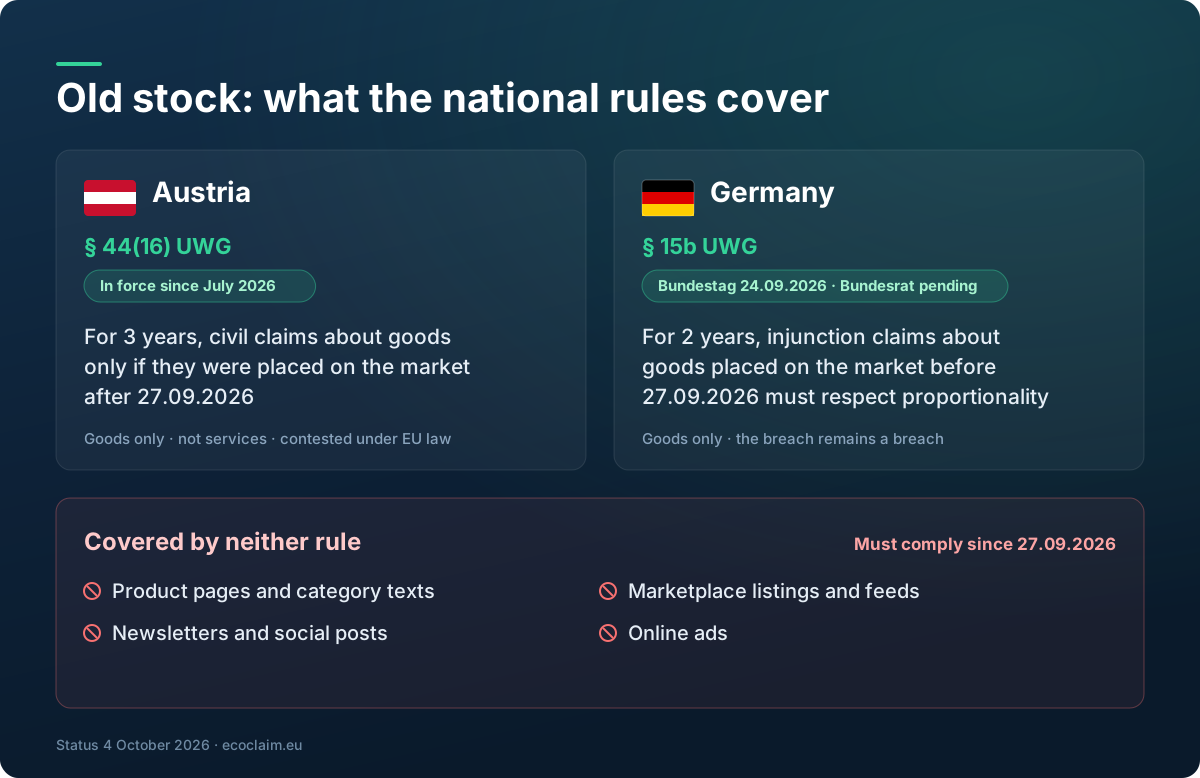
Austria: three years for goods already on the market
Austria implemented the directive through an amendment to its Act against Unfair Competition, published in the Federal Law Gazette (BGBl. I No. 58/2026) on 28 July 2026. Its transitional provision, section 44(16) UWG, says that for three years after the new rules take effect, civil claims concerning breaches relating to goods can only be brought if the goods were placed on the market after 27 September 2026.
- What it covers: civil claims, meaning those brought by competitors, protective associations and consumer organisations, about goods that were already on the market before the cut-off date.
- What it does not cover: services, and anything outside Austria. The Austrian Chamber of Commerce (WKO) points out both limits explicitly.
- What is unclear: the rule is tied to the goods and when they were placed on the market, not to where the claim appears. Whether it also shields online advertising for those goods is not settled. The cautious reading is not to rely on it for web shop texts.
- What is contested: the directive is fully harmonising, and the rule has been challenged as incompatible with it, including through a complaint by Greenpeace Austria to the European Commission. If the Commission or a court agrees, the protection may not last the full three years.
Germany: proportionality for two years, still pending
Germany took a narrower route. On 24 September 2026, three days before the rules applied, the Bundestag passed a new section 15b UWG as part of a bill amending design law. It does not block claims. It tells courts that injunction claims for breaches of the new rules, concerning goods placed on the market before 27 September 2026, must be enforced in good faith and with regard to proportionality.
According to the SPD parliamentary group, part of the governing coalition, courts have to weigh the severity of the breach, the efforts the business has made to remedy it, and the costs and environmental impact of remedying it. The provision is meant to apply from 27 September 2026 and to expire after two years, on the assumption that old stock will have sold through by then.
As of 4 October 2026, section 15b UWG has passed the Bundestag but still has to clear the Bundesrat, whose next plenary session is on 16 October, and be published in the Federal Law Gazette. It is intended to apply from 27 September, but until it is published, nobody can rely on its final wording. We will update this article after the Bundesrat session.
Even once in force, section 15b is not a safe harbour. The breach remains a breach; only how a court enforces the claim to stop it changes. Legal commentators also stress what it leaves out: services, and any advertising that is not on or attached to the goods themselves. A business that can show it has stopped selling with the old claim wherever it could, and has a plan for the remaining stock, is in the strongest position under it.
What neither rule covers: your website
Both rules exist because a printed claim on packaging cannot be changed once it has left the factory. A website can be changed in minutes, and neither legislature extended the relief to it. Product pages, category texts, marketplace listings, product feeds, newsletters, social posts and online ads have had to comply since 27 September 2026, in Austria and Germany as everywhere else in the EU, including for the very products that are still sold in old packaging.
That creates an odd but real situation: a box can still say 'climate neutral' while the product page selling it may not. A product photo that shows the old packaging with the claim clearly visible is part of your online advertising too. Where you can, use a pack shot without the claim, or crop it, and make sure the text around it does not repeat it.

What to do with old stock now
- Separate the two problems. List the claims on packaging still in stock, and separately the claims in your online communication. Only the first list can benefit from the national rules, and only in Austria and Germany.
- Fix everything online first. Product pages, feeds, listings and newsletters. A free website check shows where the claims are, and a Site Sweep covers up to 1,000 pages if the catalogue is large.
- Document the stock. When the goods were placed on the market, how many units remain, how long they will take to sell, and what relabelling would cost. In Germany, exactly these points are what a court will weigh.
- Change the packaging at the next print run. Both rules only cover goods that were already on the market. Anything produced from now on must comply.
- Check the other countries you sell into. The directive applies EU-wide; a relief in Austria or Germany does not protect the same box when it is sold in France or Italy.
If a warning letter arrives in Germany about a claim on old packaging, the date the goods were placed on the market and the steps you have taken are what to put forward, together with legal advice. Our warning-letter guide explains how the process works, and the EmpCo checklist covers the rest of the shop.
Find the claims you can still change
Your website is not covered by any old-stock rule. Check which claims are on it today, with the rule behind each one.
Check my siteSources
- SPD parliamentary group, press release of 25 September 2026 on old stock (German)
- Haufe, what section 15b UWG means (German, 25 September 2026)
- LHR Rechtsanwälte, EmpCo transition for old stock (German)
- netz-trends.de, Austria's three years and Germany's section 15b (German)
- WKO, environmental advertising: new rules from 2026 (German)
- Grant Thornton Austria, UWG amendment and EmpCo (German)
- Directive (EU) 2024/825 (EUR-Lex)
FAQ
Is there an EU-wide transition period for old stock?
No. Directive (EU) 2024/825 has no transition period. Austria and Germany added national rules for goods already on the market; they apply only in those countries.
Does the old-stock rule cover my online shop?
No. Both rules concern goods and their packaging. Product pages, listings, feeds, newsletters and online ads have had to comply since 27 September 2026, also for products still sold in old packaging.
Is section 15b UWG already in force?
As of 4 October 2026, no. It passed the Bundestag on 24 September 2026 and still has to clear the Bundesrat (next session 16 October) and be published. It is intended to apply from 27 September 2026 for two years.
Does section 15b mean I cannot be warned about old packaging in Germany?
No. Competitors and associations can still bring claims. Courts must weigh proportionality, including the severity of the breach, your efforts to remedy it and the cost and environmental impact of doing so. It reduces the risk; it does not remove it.
How long does the Austrian rule last?
Three years from when the new rules took effect. It covers civil claims about goods placed on the market before 27 September 2026, not services, and it has been challenged as incompatible with EU law.
Free account
Keep your compliance work in one place
Scans you run while signed out disappear when you close the tab.
- Save every scan and come back to it later
- See whether your score improves after you fix things
- Store certificates against the claims they prove