Black Friday 2026 Rules for Online Shops: Discounts, Countdowns and Checkout (Checklist)

Black Friday 2026 falls on 27 November, with Cyber Monday on 30 November. For most online shops it is the busiest week of the year, and for consumer authorities it is the week they look hardest at how discounts are shown.
In March 2026 the European Commission and consumer authorities from 23 EU countries, Iceland and Norway published their check of last year's Black Friday and Cyber Monday sales. Of 314 online traders, 30% showed discounts incorrectly. 18% used pressure tactics such as countdown timers or scarcity claims, more than half of them misleading, and 36% tried to add optional items to the shopping basket.
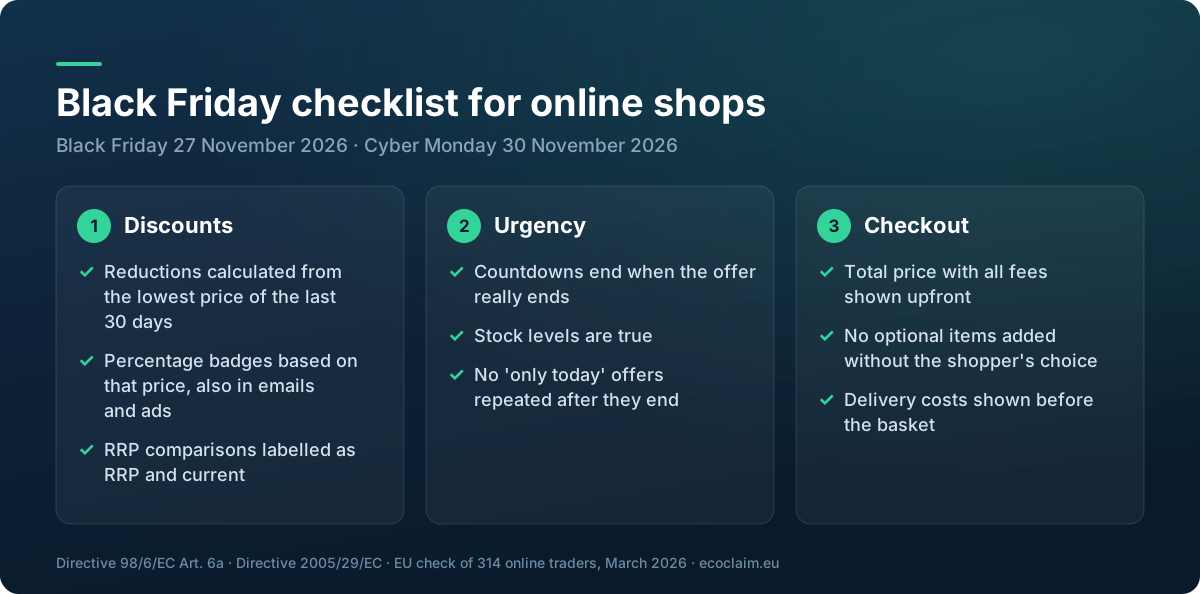
A discount must be measured against the lowest price you charged in the 30 days before it. A comparison with an RRP must say so. A countdown or 'only 2 left' must be true. And the checkout must show every fee upfront and add nothing the shopper did not choose.
Rule 1: discounts must use the 30-day lowest price
Since 28 May 2022, EU law (Article 6a of the Price Indication Directive) requires that any announced price reduction shows the prior price, which is the lowest price you applied in at least the 30 days before the reduction. In Germany this is § 11 of the Price Indication Ordinance (PAngV); in Austria § 9a of the Price Labelling Act.
In the Aldi Süd case (C-330/23, 26 September 2024), the EU Court of Justice added that a percentage reduction or a 'price highlight' claim must be calculated from that 30-day lowest price. Showing the 30-day price somewhere next to it is not enough if the percentage is based on a higher price. Our post on the 30-day lowest price rule explains the calculation, the exceptions and the most common mistakes.

Rule 2: crossed-out prices and RRPs must say what they are
A crossed-out price that is your own former price counts as a price reduction, so the 30-day rule applies. A comparison with a manufacturer's recommended retail price (RRP, in German UVP) is treated differently, but only if it is clearly labelled as an RRP, the RRP is current, and it is a price the market actually charges. The EU check found that 6 in 10 shops comparing prices did not clearly explain what the reference price was.
Rule 3: countdowns and 'only 2 left' must be true
Falsely claiming that an offer is only available for a very limited time is banned in every EU country, with no need to prove harm. A countdown that resets when it reaches zero, an 'only today' deal that comes back tomorrow at the same price, or a stock level that never changes are the classic cases. Our post on countdown timers and fake urgency goes through what courts have decided.
Rule 4: the checkout must not add anything or hide fees
- No optional extras added for the shopper. Insurance, gift wrapping or a donation must be chosen actively, never pre-ticked. The EU check found 36% of shops tried to add optional items, 4 in 10 of them without clearly asking.
- The total price, upfront. Show the final price including VAT, and state delivery costs before the basket. 10% of shops in the EU check added fees late in the checkout.
- Coupons and conditions in plain words. If a code only works on some products or above a minimum order, say so next to the offer.
Who checks, and what happens
National consumer authorities follow up on the EU check and can act against the shops concerned, coordinated across borders by the Consumer Protection Cooperation network. In Germany, competitors and consumer associations can also send warning letters (Abmahnungen) for price information that breaks the rules; incorrect strike-through prices are among the most common reasons. Our post on greenwashing warning letters explains how that procedure works.
How to prepare your shop before Black Friday
- Export the price history of every product you plan to discount, and note its lowest price in the 30 days before the sale starts.
- Base every percentage on that price, in badges, banners, emails and ads, not only on the product page.
- Label RRP comparisons as RRP and check they are current.
- Set countdowns to the real end of the offer, and let them end. Do not restart them.
- Show real stock levels or none at all.
- Click through your own checkout once: nothing pre-ticked, every fee visible before payment.
- Check your product pages too: shops rush new landing pages and product texts out before Black Friday, and that is when vague green claims and missing product safety details slip in.
For that last point, EcoClaim's free scan checks your product pages for green claims under the EmpCo rules and for the product safety details the GPSR requires, so the pages you send Black Friday traffic to are clean.
Check your product pages before the Black Friday rush
Scan your shop for vague green claims and missing product safety details (GPSR) before the busiest week of the year. Free to start, results in minutes.
Scan my shopSources
- European Commission: EU check reveals misleading sales practices online (26 March 2026)
- Directive 98/6/EC on price indication, Article 6a (as amended by Directive (EU) 2019/2161), EUR-Lex
- Court of Justice of the EU, C-330/23 Aldi Süd, 26 September 2024 (press release)
- German Price Indication Ordinance (PAngV), § 11
- Directive 2005/29/EC on unfair commercial practices, Annex I point 7, EUR-Lex
FAQ
When is Black Friday 2026?
Friday 27 November 2026. Cyber Monday is on 30 November 2026. Many shops run Black Week offers in the days before.
Do I have to show the lowest price of the last 30 days on Black Friday?
Yes, for every announced price reduction on goods. The reduction must be measured against the lowest price you charged in at least the 30 days before it, and a percentage must be calculated from that price.
Can I use the RRP as a crossed-out price?
Yes, if it is clearly labelled as the manufacturer's recommended retail price, is still current and is a realistic market price. It must not look like your own former price.
Are countdown timers allowed on Black Friday?
Yes, if they count down to the real end of the offer and the offer actually ends. A timer that restarts, or an 'only today' deal that returns at the same price, is misleading.
What did the EU's last Black Friday check find?
Of 314 online traders checked, 30% showed discounts incorrectly, 34% compared prices and 6 in 10 of those did not explain the reference price, 18% used pressure tactics, and 36% tried to add optional items to the basket. The results were published on 26 March 2026.
Does EcoClaim check my Black Friday prices?
Not yet. EcoClaim checks green claims and product safety (GPSR) on your pages today. Use this checklist for your prices, and scan the pages you send Black Friday traffic to for the rest.
Free account
Keep your compliance work in one place
Scans you run while signed out disappear when you close the tab.
- Save every scan and come back to it later
- See whether your score improves after you fix things
- Store certificates against the claims they prove