Greenwashing Warning Letters in Germany (Abmahnung): Who Can Send One and What to Check
In most EU countries a misleading environmental claim becomes a problem when an authority opens a file. In Germany it usually starts differently: with a letter from another company's lawyer. The German implementation of Directive (EU) 2024/825, the Third Act amending the Act against Unfair Competition (UWG), was published on 19 February 2026 and applies from 27 September 2026, with no transition period for existing websites, packaging or campaigns. From that day the claims it prohibits can be enforced by anyone the UWG entitles to act, and the instrument they use is the Abmahnung, a formal warning letter.
This concerns every business that advertises to consumers in Germany, wherever it is based. This article explains who can send such a letter, what it asks for and what it costs, why the second letter is the expensive one, and the six things to check on your website before either arrives.
This article is written for marketing and compliance teams who want to understand the mechanism. If you receive an Abmahnung, have it reviewed by a lawyer before you sign or pay anything.
Who can send a greenwashing Abmahnung
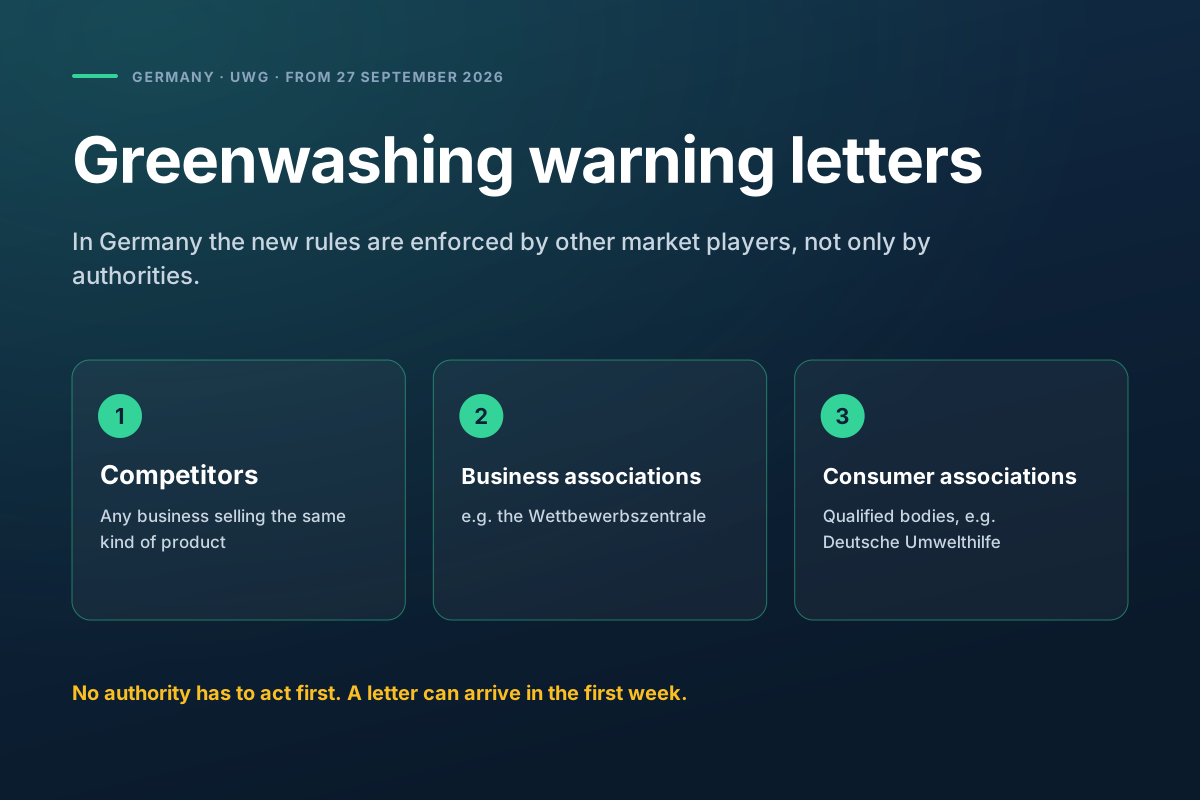
Section 8(3) UWG gives four groups the right to demand that an unfair commercial practice stops:
- Competitors: any business that sells goods or services of the same kind to the same customers.
- Business associations that meet the statutory requirements. The best known is the Wettbewerbszentrale, which brought the 'klimaneutral' case that reached the Federal Court of Justice in 2024.
- Qualified consumer associations on the official list, such as Deutsche Umwelthilfe, which has pursued climate-neutral and net-zero advertising for years.
- Chambers: chambers of industry and commerce and chambers of crafts.
None of them has to wait for an authority. That is the practical difference to most other member states, and the reason the first German cases are expected soon after 27 September rather than after a lengthy investigation. Your exposure does not depend on how busy a regulator is. It depends on whether a competitor, or an association with a campaign, reads your product pages.
What the letter asks for, and what it costs
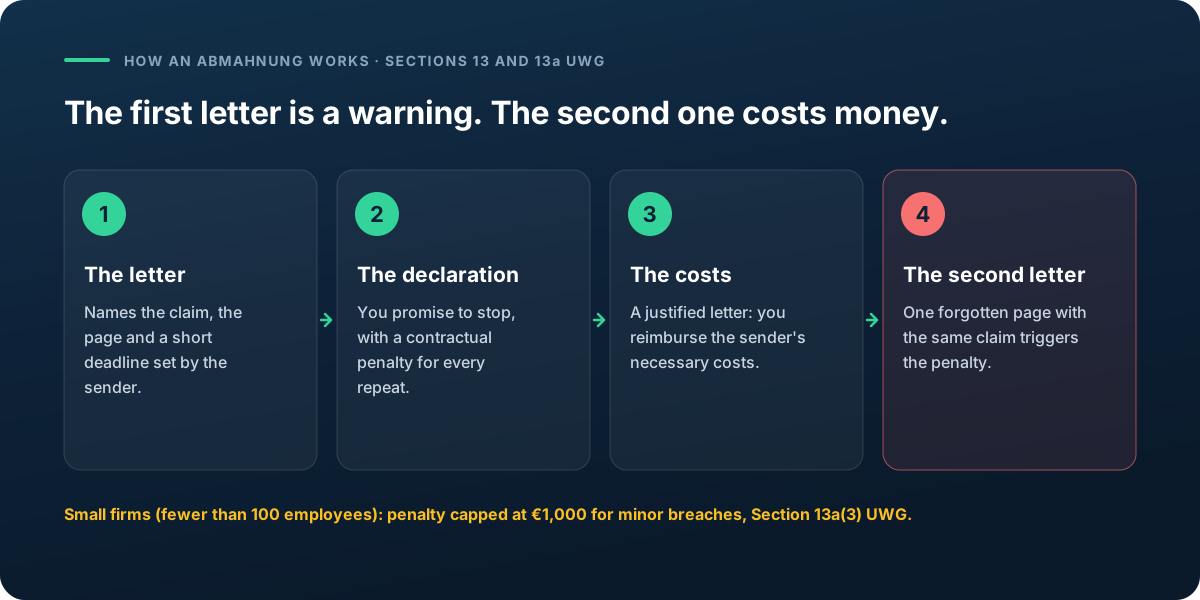
Under Section 13 UWG a warning letter must state who sends it and on whose behalf, why they are entitled to act, what the infringement is and the facts behind it, and whether and how much they claim in costs. It then asks for two things:
- A cease-and-desist declaration with a penalty clause (strafbewehrte Unterlassungserklärung): a written promise to stop using the claim, backed by a contractual penalty payable for every future breach.
- Reimbursement of costs: if the warning is justified and meets the formal requirements, the sender can claim its necessary expenses, in practice usually its lawyer's fees.
The deadline is set by the sender and is usually short. If it passes without a sufficient declaration, the sender can go to court for an injunction, often as a preliminary injunction (einstweilige Verfügung) decided within days. Breaching a court injunction can lead to court-ordered penalties of up to €250,000 per breach (Section 890 ZPO).
Two rules soften this for small businesses, and it is worth knowing their limits. The contractual penalty may not exceed €1,000 where the breach only insignificantly affects consumers and competitors and the business usually employs fewer than 100 people (Section 13a(3) UWG). And the rule that excludes cost reimbursement in some cases applies to letters from competitors about missing legal information online and about data protection, not to misleading environmental claims.
Why the second letter is the expensive one
Signing the declaration usually ends the first dispute at a manageable cost. It also starts an obligation with no end date: the promise covers every page, channel and document where the business uses the claim, not only the page named in the letter. A product datasheet from 2022, a blog post, a marketplace listing or an old campaign page that still says the same thing is a new breach, and each breach triggers the agreed penalty.
So the order matters: find every place the claim appears, change it, and only then sign. On a site with a few pages that is an afternoon. On a shop or a group site with hundreds of pages it is a search across the whole site, not a look at the page in the letter. That is the job Site Sweep was built for: it reads the text of up to 1,000 pages at once and lists every page that carries the same wording.
What the first letters are likely to be about
The amendment adds practices that are unfair in all circumstances, with no test of whether a consumer was actually misled. In plain words:
- Climate neutrality based on offsetting: 'klimaneutral', 'CO₂-neutral' or 'klimapositiv' for a product, where the claim rests on purchased certificates rather than reductions in its own value chain.
- Generic environmental claims: 'umweltfreundlich', 'nachhaltig', 'grün', 'öko' and similar words, without recognised excellent environmental performance or the specific facts on the same medium.
- Self-made sustainability labels: seals and badges that are not based on a certification scheme or established by a public authority, including those that appear only in product images.
- Whole-product claims about one part: 'recyclable' when only the packaging is, 'made from recycled material' when only one component is.
- Presenting a legal requirement as a feature that sets the product apart.
Future claims such as 'net zero by 2040' are not banned outright, but they now need a detailed and realistic implementation plan with measurable targets, verified regularly by an independent expert. And the case law that existed before the amendment still applies: in June 2024 the Federal Court of Justice held that an ambiguous term like 'klimaneutral' must be explained in the advertisement itself (I ZR 98/23). Every restricted term, with what to write instead, is in our banned words list.
Six things to check before a letter arrives
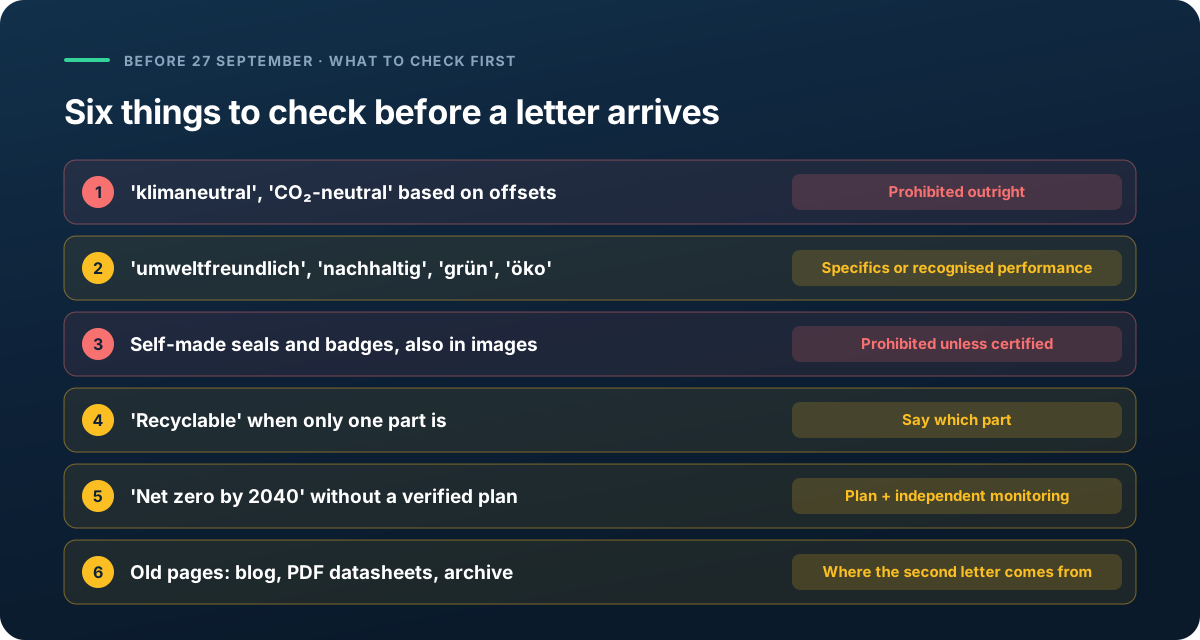
- Search the whole site for climate-neutrality claims and ask what each one rests on. If the answer is offsets, the claim goes.
- Find the generic words and replace each with the specific fact on the same page, or remove it.
- Look at your images, not only your text. Seals, leaf icons and badges on product photos are claims too, and a text search will not find them. A free website check reads the images on the page as well as the copy.
- Check the scope of every 'recyclable', 'recycled', 'plastic-free' or 'biodegradable': the whole product, or one part? Say which part.
- List your targets. Every 'net zero by' or 'climate-neutral by' needs the plan behind it, independently verified, or it has to be rewritten.
- Go through the old material: blog posts, PDF datasheets, press releases hosted on your site, marketplace listings. This is where the second letter comes from.
Keep a dated record of what you checked and what you changed. If a letter arrives, it is the first thing your lawyer will ask for, and it shows that the claim was an oversight rather than a policy.
If a letter arrives anyway
- Note the deadline and do not let it pass. Silence is the quickest route to a court order.
- Do not sign the enclosed declaration as drafted before a lawyer has read it. Pre-drafted declarations are often broader than the infringement, and a modified declaration is common practice.
- Check the formal requirements of Section 13(2) UWG. A letter that does not meet them may not entitle the sender to its costs.
- Change the claim everywhere before you sign, not only on the page named in the letter.
See what a warning letter would find
Paste your URL: the free check reads your key pages against the directive and the German rules, text and images, and lists every claim with what to write instead. No account needed.
Check my siteSources
- BMJV, Third Act amending the Act against Unfair Competition (BGBl. 2026 I No. 43, 19 February 2026)
- Section 8 UWG, who is entitled to claim
- Section 13 UWG, requirements of a warning letter and costs
- Section 13a UWG, contractual penalty
- Section 890 ZPO, penalties for breaching an injunction
- Federal Court of Justice, I ZR 98/23, 27 June 2024 ('klimaneutral')
- Directive (EU) 2024/825 (EUR-Lex)
FAQ
Who can send a greenwashing Abmahnung in Germany?
Competitors, business associations that meet the statutory requirements (such as the Wettbewerbszentrale), qualified consumer associations (such as Deutsche Umwelthilfe) and chambers of commerce and crafts, under Section 8(3) UWG. None of them has to wait for an authority to act.
Does it apply to companies outside Germany?
Yes, if the advertising is aimed at consumers in Germany. German unfair competition law applies where the advertising has its effect: a website in German that sells and delivers to Germany can be warned under the UWG wherever the company is based.
How much does a greenwashing Abmahnung cost?
There is no fixed tariff. A justified letter entitles the sender to its necessary costs, usually lawyer's fees calculated from the value in dispute. Your own lawyer comes on top, and if you later breach a signed declaration, the agreed contractual penalty is due for each breach. For businesses with fewer than 100 employees and minor breaches, the penalty is capped at €1,000.
Should I sign the cease-and-desist declaration?
Not as drafted and not before a lawyer has read it. Pre-drafted declarations are often broader than the infringement. And before signing, change the claim everywhere it appears, because any later repeat triggers the penalty.
Is removing the claim after the letter enough?
Usually not on its own. Under German case law the risk of repetition that justifies the claim is generally removed only by a declaration backed by a penalty, or by a court decision. Removing the claim is necessary, but it does not end the dispute by itself.
Free account
Keep your compliance work in one place
Scans you run while signed out disappear when you close the tab.
- Save every scan and come back to it later
- See whether your score improves after you fix things
- Store certificates against the claims they prove