The 30-Day Lowest Price Rule: How to Show Discounts and Crossed-Out Prices Correctly
Since 28 May 2022, every price reduction announced to consumers in the EU has to be measured against one specific price: the lowest price the seller charged in at least the 30 days before the reduction. The rule comes from Article 6a of the Price Indication Directive, added by the Omnibus Directive (EU) 2019/2161. In Germany it is § 11 of the Price Indication Ordinance (PAngV).
It sounds simple, yet in the EU's check of Black Friday 2025 sales, 30% of 314 online traders still got it wrong. Here is how it works, with an example, and how it affects your Black Friday preparation.
When you announce a price reduction on goods, the 'before' price you show, and any percentage you advertise, must be based on the lowest price you charged for that product in the 30 days before the reduction started.
A worked example
A jacket normally costs €99. Three weeks before Black Friday it was on sale for one week at €59. On Black Friday you sell it for €49.
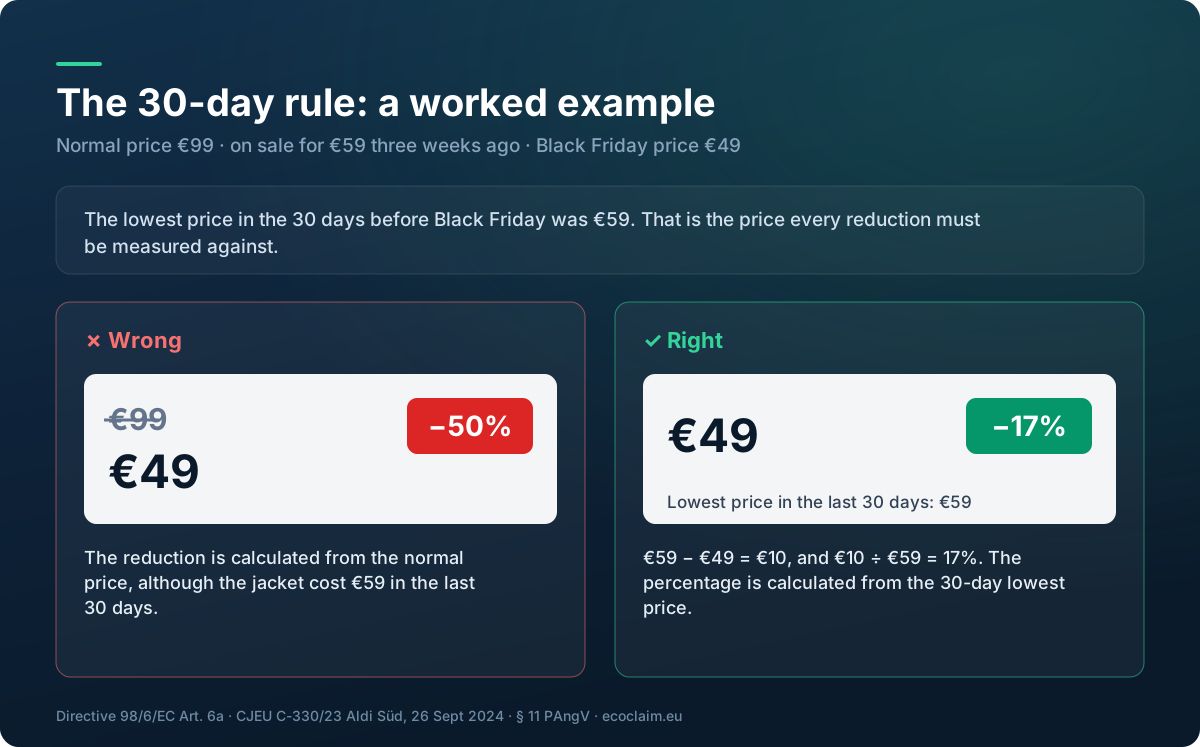
- Wrong: was €99, now €49, '−50%'. The reference price is not the lowest price of the last 30 days.
- Also wrong after the Aldi Süd ruling: was €99, now €49, '−50%', with 'lowest price in the last 30 days: €59' in small print. The percentage must be calculated from €59.
- Right: €49, '−17%', with 'lowest price in the last 30 days: €59' as the reference price.
The Court of Justice of the EU decided this in the Aldi Süd case (C-330/23, 26 September 2024): a reduction announced as a percentage, or as a statement such as 'price highlight', must be determined on the basis of the 30-day lowest price. The German court that referred the case applied the ruling against the retailer in October 2024.
What counts as a price reduction
- Covered: crossed-out former prices, 'was/now', percentage badges, '−€20', 'reduced', 'price highlight' or 'sale price' claims about your own earlier price, in your shop, newsletters, banners and ads.
- Not covered by the 30-day rule: general price comparisons that do not claim a reduction of your own price, such as a clearly labelled RRP comparison (see below), and individual discounts given to one customer.
- Still covered by the rules on misleading practices: everything. Even where the 30-day rule does not apply, a price comparison must not mislead.
The exceptions
Progressive reductions. If you lower a price in steps without interruption (for example −10%, then −20%, then −30% during one sale), the prior price can stay the lowest price before the first step. If you return to the normal price in between, the count starts again.
Perishable goods. Germany exempts goods that spoil quickly or are close to their best-before date, if the price is cut for that reason and the shopper is told so. 'Special offer' alone does not qualify.
Individual reductions. A personal code sent to one customer is not an announced price reduction. Once the code is published for everyone, the rule applies again.
Crossed-out RRPs: allowed, with conditions

A comparison with the manufacturer's recommended retail price (RRP, in German UVP) is not a reduction of your own price, so in the prevailing view the 30-day rule does not apply to it. But German courts set three conditions:
- It must be labelled as an RRP, for example 'RRP' or 'manufacturer's recommended price'. 'List price', 'regular price' or a bare crossed-out figure are risky.
- It must be current. An RRP the manufacturer has withdrawn cannot be used without saying so.
- It must be realistic. An appeal court (OLG Stuttgart) held that an RRP only serves as a fair comparison if the market actually charges it; an RRP that exists only to make discounts look bigger is misleading.
The EU check found that 6 in 10 shops comparing prices did not clearly explain the reference price. Label it.
Common mistakes
- Raising the price shortly before the sale, so the 'reduction' starts from a price that was never the 30-day lowest.
- Percentage badges calculated from the normal price while the 30-day price is shown separately.
- Reductions only fixed on the product page, while newsletters, banners and ads still show the old percentage.
- Marketplace listings left out: the same rule applies to your Amazon, eBay or OTTO offers.
- 'Up to −70%' banners where hardly any product reaches 70% from its 30-day price.
Checking your shop before Black Friday
Export the price history of every product you plan to discount, note the lowest price of the 30 days before the start date, and base every percentage on it. Then check every place the discount appears, not only the product page. Our Black Friday checklist covers countdowns and the checkout as well.
Make your Black Friday pages clean
While you fix your prices, scan the pages you send Black Friday traffic to for vague green claims and missing product safety details (GPSR). Free to start.
Scan my shopSources
- Directive 98/6/EC on price indication, Article 6a, EUR-Lex
- Court of Justice of the EU, C-330/23 Aldi Süd, 26 September 2024 (press release)
- German Price Indication Ordinance (PAngV), § 11
- European Commission: EU check reveals misleading sales practices online (26 March 2026)
- Händlerbund: RRP as strike-through price only if actually charged (on OLG Stuttgart)
FAQ
What is the 30-day lowest price rule?
When you announce a price reduction on goods to consumers in the EU, the prior price you show must be the lowest price you charged in at least the 30 days before the reduction. It applies since 28 May 2022.
Must the percentage discount be calculated from the 30-day lowest price?
Yes. The EU Court of Justice decided in the Aldi Süd case (C-330/23) that a percentage reduction must be calculated from the 30-day lowest price. Showing that price next to a percentage based on a higher price is not enough.
Does the 30-day rule apply to RRP comparisons?
In the prevailing view, no, because comparing with a manufacturer's RRP is not a reduction of your own price. The RRP must still be labelled as such, current and realistic.
What about a product I have only sold for two weeks?
Then there are no 30 days of history. Use the lowest price you have charged since you started selling it, and do not suggest a longer reference period.
Does the rule apply to services?
The 30-day rule covers goods. Price reductions on services are still subject to the general ban on misleading price information.
Does it apply on marketplaces like Amazon?
Yes. Your offers on marketplaces are your price announcements. The same rule applies to them.
Free account
Keep your compliance work in one place
Scans you run while signed out disappear when you close the tab.
- Save every scan and come back to it later
- See whether your score improves after you fix things
- Store certificates against the claims they prove