GPSR Checklist and Free GPSR Checker: The Four Things Every EU Product Page Must Show

The General Product Safety Regulation (GPSR, Regulation (EU) 2023/988) has applied since 13 December 2024. It replaced the old product safety directive and added a rule that matters to every online shop: the offer itself must show the information a shopper would otherwise find on the product or its box.
That rule is Article 19. It applies to your own shop, to marketplace listings and to every other kind of distance sale, and it covers almost all consumer products, including those that also carry a CE mark. You can check your product pages with our free GPSR checker as part of any EcoClaim scan; below is what the check looks for.
Every product page needs four blocks: the manufacturer with postal and electronic address, an EU responsible person if the manufacturer is outside the EU, information that identifies the product, and its warnings in the shopper's language. They must be on the offer, not only in your footer or a separate document.
The four blocks
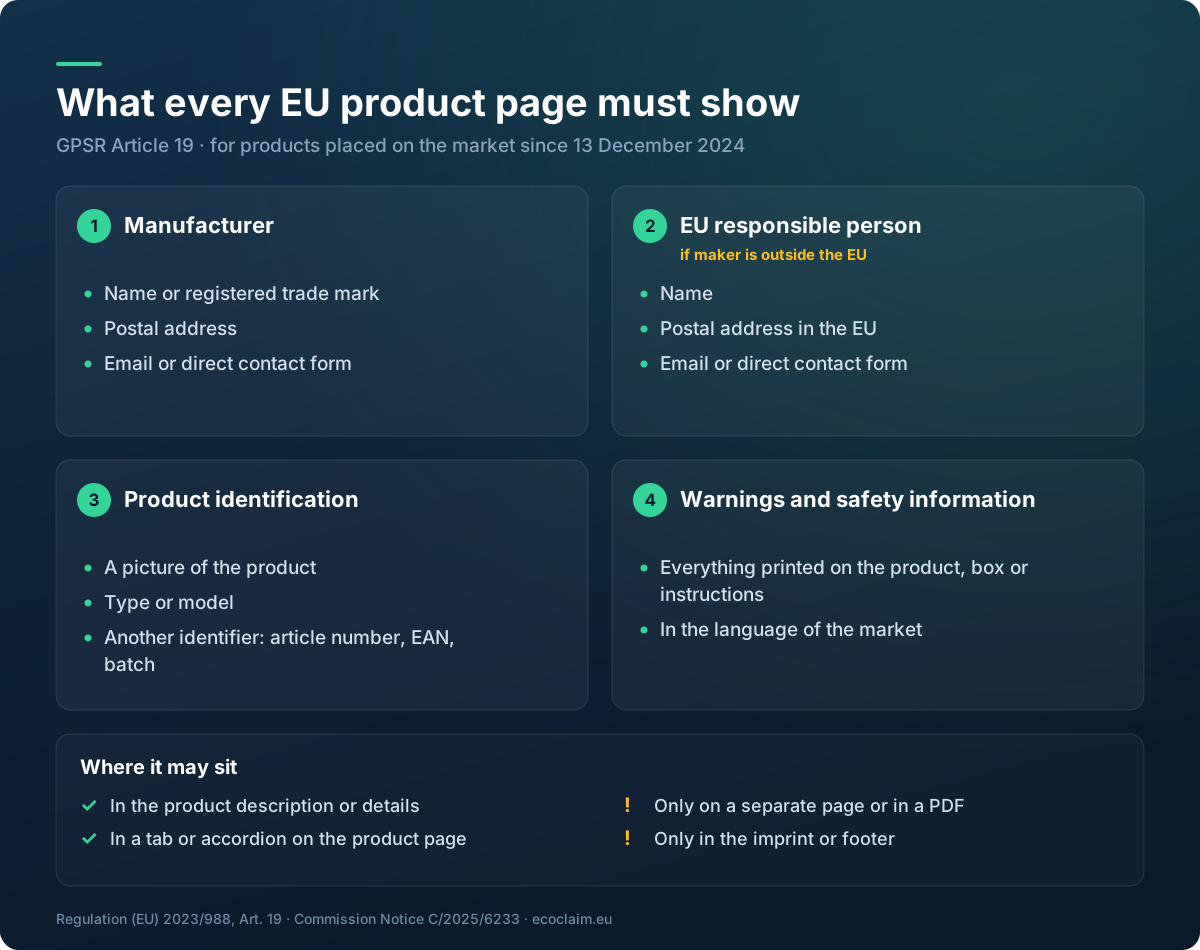
1. The manufacturer. Its name, registered trade name or registered trade mark, plus a postal address and an electronic address where it can be contacted. If you make the product yourself, that is your company. A logo or 'see packaging' is not enough.
2. The EU responsible person. Only needed when the manufacturer is established outside the EU, for example in the UK, the US, Switzerland or China. Then the offer must also give the name, postal address and electronic address of the economic operator responsible for the product in the EU. Our post on the EU responsible person explains who can take that role.
3. Product identification. A picture of the product, its type, and any other identifier it has: a model or article number, an EAN, a batch or serial number. A generic title like 'Desk lamp' with no model makes a product hard to identify, which matters most when something has to be recalled.
4. Warnings and safety information. Any warning or safety information that has to be on the product, its packaging or the instructions must also be in the offer, in a language shoppers in that country can easily understand. For many products, such as most clothing or furniture, there is none. For toys, cosmetics, electrical goods or cleaning products there usually is; our post on warnings and safety information goes through them.
What counts as an electronic address

The European Commission's guidance on the GPSR (Notice C/2025/6233, section 3.1.1) says an electronic address can be an email address or a dedicated section of a website, such as a contact form. A website on its own is not enough if it does not let people contact the manufacturer directly. A phone number is not an electronic address.
In practice, an email address is the safest choice. If you use a contact form, link straight to it, not to a homepage.
Where the information may sit
Article 19 says the offer must show the information 'clearly and visibly'. The Commission's guidance does not say whether a tab or an accordion is enough, and no court has ruled on it. The prevailing view in German practice is that the product description and the product details area of the offer page are fine, including folded sections, while a bare link to a separate page or a PDF is not enough.
- Fine: a 'Manufacturer information' or 'Product safety' block in the product description or details, including in a tab or accordion on that page.
- A risk: a link to a general 'manufacturers' page, a PDF data sheet, or details only in the imprint or footer.
- Not enough: details stored in your shop system or marketplace account that do not appear for the shopper.
What a German court decided
In Germany, competitors can enforce these rules against each other. The Regional Court of Hechingen (23 April 2026, 5 O 37/25 KfH), as reported by several German legal publishers, dealt with marketplace listings on which the manufacturer details did not appear in the German view, although the seller had stored them and they showed in another language view.
The court treated the missing details as withholding essential information under the German unfair competition act (§§ 5a, 5b UWG), which gives competitors a claim to stop it. The seller could not rely on a platform error: what counts is what the consumer actually sees.

The requirement applies to products placed on the EU market since 13 December 2024. Products lawfully placed on the market before that date may still be sold (Article 51 GPSR; the Regional Court Berlin II took the same view in a decision reported in July 2026). For anything you list today, add the information anyway: you rarely know the date a specific item was first placed on the market.
An example block you can copy
A simple block at the end of the product description covers the first two items. In German, for a manufacturer in the EU:
Hersteller: [Firmenname], [Straße Nr.], [PLZ Ort], [Land], [E-Mail-Adresse]
For a manufacturer outside the EU, add a second line with the EU responsible person, in the same format. Add the article number and, if you have one, the EAN in the product details, and copy the warnings from the packaging into a 'Safety information' section.
Free GPSR checker: scan and fix every product page
Checking one page is easy. Checking hundreds is where shops slip: one template without the block, one brand without an EU contact, one category without warnings. EcoClaim reads each product page in a scan the way a shopper would, including folded tabs and Amazon's product safety panel, and reports one of six results for each block:
- Shown: the information is on the offer.
- Incomplete: some of it is missing, for example an address without an email.
- Separate page: it is only on another page or in a document.
- Not found: we could not find it on the page.
- Couldn't confirm: we could not tell, for example because the page did not load fully. This is never counted as a breach.
- Doesn't apply: the product is outside the GPSR, such as food or medicines, or the page does not sell a single product.
The product safety check is free in every scan you run from an EcoClaim account, free accounts included, and in every Site Sweep. After you fix a page, the re-check is free too. Each finding comes with a block you can paste.
Run a free GPSR check
Run a scan and see, for every product page, whether the manufacturer, the EU contact, the product ID and the warnings are shown. The safety check is free in every scan, and so is the re-check after you fix it.
Check my product pagesSources
- Regulation (EU) 2023/988 (General Product Safety Regulation), EUR-Lex
- Commission Notice C/2025/6233, guidance on the GPSR for businesses, EUR-Lex
- IT-Recht Kanzlei: warning letters for missing manufacturer details under the GPSR
- versandhandelsrecht.de: sellers liable for missing manufacturer details, even with platform errors (on LG Hechingen)
FAQ
Does the GPSR apply to my online shop?
If you sell consumer products to people in the EU, almost certainly yes. It applies to your own shop, marketplace listings and other distance sales. Food, medicines, living plants and animals and a few other categories are outside it.
Is a tab or accordion on the product page enough?
In the prevailing view in German practice, yes: it is part of the offer. No court has ruled on it. A bare link to a separate page or PDF is seen as a risk.
Is a phone number enough as contact?
No. Article 19 asks for a postal address and an electronic address. The Commission's guidance says an email address or a dedicated contact form works; a homepage alone or a phone number does not.
I make the products myself. What do I show?
Your own company as manufacturer: name, postal address and email. If your company is in the EU, you do not need a separate EU responsible person.
What about products I bought before December 2024?
Products lawfully placed on the EU market before 13 December 2024 may still be sold. For current listings, adding the information is the safe choice, because you rarely know when a specific item was first placed on the market.
Does the EcoClaim check cost extra?
No. It runs in every scan from an EcoClaim account, including free accounts, and in every Site Sweep. Re-checking after a fix is free.
Free account
Keep your compliance work in one place
Scans you run while signed out disappear when you close the tab.
- Save every scan and come back to it later
- See whether your score improves after you fix things
- Store certificates against the claims they prove