EmpCo Triage: What to Fix First, Ranked by Real Risk
On 27 September 2026 the Empowering Consumers for the Green Transition Directive (EU) 2024/825 — EmpCo — applies across all 27 member states. From the day this article publishes, that is one month. There is no transition period and no grandfathering for copy that was written before the rules changed.
The directive has applied since 27 September 2026. This article was written before that date: where it says 'before 27 September', read 'now'. Everything it tells you to check and fix still applies.
If you are reading this with a month left, you are probably not going to review every environmental claim on your site. That is the honest starting position, and it is fine — because the claims on your pages are not equally dangerous, and the difference is much larger than most teams assume. We have scanned 680 EU websites against the directive, and the pattern in that data is counter-intuitive enough to change what you should do first.
After 27 September, a general environmental claim is a prohibited commercial practice unless you can demonstrate recognised excellent environmental performance. The evidence has to be on the same page as the claim — not in a sustainability report, not two clicks away, not on request. A claim your customer cannot verify where they read it is an unsubstantiated claim.
Frequency and risk run in opposite directions
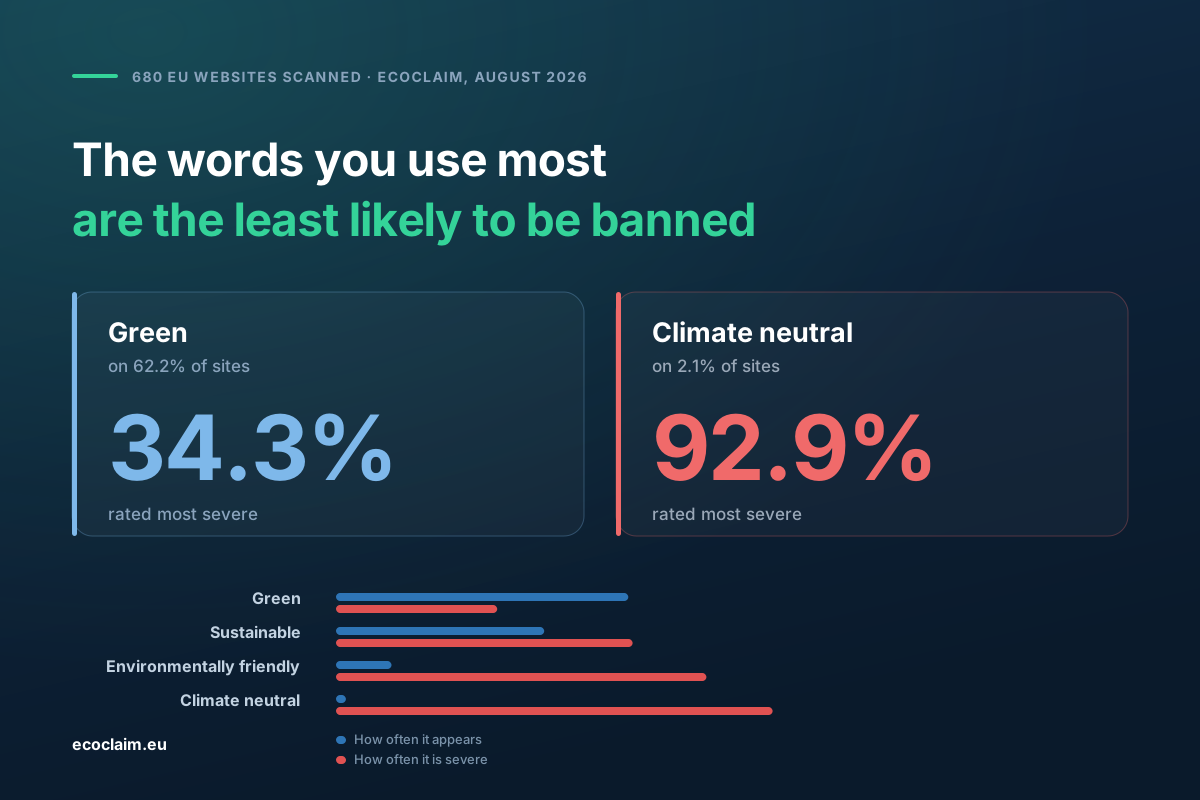
The instinct is to start with the words you use most. In our corpus that is exactly backwards. Across 680 scanned sites, the single most common flagged term is "green" — it appears in a flagged claim on 62.2% of them. But of those sites, only 34.3% had it rated at the highest severity. Meanwhile "climate neutral" appears on just 2.1% of sites, and 92.9% of those are red-rated.
The reason is legal, not stylistic. Common adjectives like "green" are usually vague, and vagueness is fixable: add the specific, substantiated claim underneath and the sentence survives. The rare terms are precise factual assertions about carbon or emissions, and a large share of them rest on offsetting — which Annex I of the Unfair Commercial Practices Directive now prohibits outright. You cannot substantiate your way out of an offset-based neutrality claim. It has to go.
Tier 1 — the claims you cannot fix, only remove
Start here, whatever else you do. These are rare enough that most sites have only a handful, and they carry the highest probability of being prohibited rather than merely unproven. The percentage is how often the term was rated red on the sites where we found it:
- Climate neutral — red on 92.9% of sites carrying it (13 of 14). Found on 2.1% of scanned sites.
- Zero emissions — red on 90.0% (9 of 10). Found on 1.5%.
- Biodegradable — red on 78.9% (15 of 19). Found on 2.8%.
- Carbon neutral — red on 76.9% (10 of 13). Found on 1.9%.
- Recyclable — red on 71.9% (23 of 32). Found on 4.7%.
- Environmentally friendly — red on 78.8% (63 of 80). Found on 11.8% — the one high-volume term in this tier.
Neither is banned as a word. Both fail when the claim is unqualified: recyclable where no collection scheme actually accepts the item, biodegradable with no stated conditions or timeframe. "Biodegradable" alone says nothing — biodegradable in an industrial composter within 12 weeks is a claim; biodegradable eventually, somewhere, is not.
Tier 2 — the high-volume words worth an afternoon
These are the terms most sites carry dozens of times. Individually each is lower risk; collectively they are where the bulk of exposure sits, simply because of volume. They are also the cheapest to fix, because in most cases the sentence survives with a substantiating clause attached.
- Green — on 62.2% of sites, red on 34.3% of those. The most common and the most forgiving.
- Sustainable — on 44.3%, red on 63.1%. Far riskier than "green" despite feeling more serious.
- Eco — on 41.9%, red on 63.5%. Usually a prefix problem: eco-line, eco-pack, eco-choice.
- Sustainability — on 30.7%, red on 55.5%.
- Natural — on 29.0%, red on 42.6%.
- Responsible — on 15.6%, red on 49.1%.
One thing worth noticing: "sustainable" is red nearly twice as often as "green". Teams tend to treat "sustainable" as the safer, more grown-up word. In the data it is not. Full per-term figures, including how often each one appears and how often it is severe, are on our banned-words reference.
Tier 3 — the claims that are not text at all
This is the tier almost everyone forgets, and it is not small. Across the same corpus, 57% of sites carried a misleading visual claim and 26% displayed a certification-style logo that does not correspond to a real certification scheme. A leaf motif on a packshot, a green badge reading "eco choice" designed in-house, a globe icon next to a product name — under EmpCo these are claims, and a self-designed sustainability label with no third-party certification behind it is specifically listed in Annex I.
Search your media library, not just your copy deck. The usual finding is a badge someone's agency made in 2019 that now sits on four hundred product images.
What "fixed" actually looks like
Three worked examples. Note that in each case the fix is not softer language — it is a specific, checkable fact placed where the reader sees the claim.
- Before: "Our climate-neutral shipping." → After: remove it. If the neutrality rests on purchased offsets, no wording saves it. If you fund emissions reductions, say what you fund, without claiming neutrality.
- Before: "Made from sustainable materials." → After: "Made from 78% recycled polyester (GRS-certified, certificate no. 12345)." The claim is now a number a customer can check.
- Before: "Eco-friendly packaging." → After: "Packaging is 100% recycled cardboard, accepted in household paper collection across DE, AT and NL." Specific, bounded by geography, verifiable.
Read the claim as a sceptical customer and ask: what exactly is being asserted, and where on this page can I check it? If you cannot answer both parts in one breath, a regulator will not be able to either.
A four-week order of work
- Week 1 — find, do not fix. Inventory every environmental claim across product pages, category text, homepage, footer, and email templates. You cannot triage what you have not listed.
- Week 2 — remove Tier 1. Every offset-based neutrality claim, every unqualified recyclable/biodegradable line. These are deletions and rewrites, not negotiations.
- Week 3 — substantiate Tier 2. Work highest-traffic pages first. Attach the number, the certificate, or the boundary to each claim, on the same page.
- Week 4 — images and evidence. Audit the media library for self-made badges and misleading motifs, then file the substantiation for every surviving claim somewhere you can retrieve it in a hurry.
What changes on 28 September
Less than people expect, and more than they would like. Enforcement begins rather than concludes: national authorities and competitors can act from that date, and in Germany the route is a UWG warning letter from a competitor long before a regulator becomes involved. Penalties reach 4% of annual turnover in the member state concerned.
The practical shift is that the question stops being "is our copy clean?" and becomes "can we show what we checked, and when?". Sites change weekly; every new product page is a new claim. A dated record of what was reviewed is worth more after the deadline than before it.
All percentages come from EcoClaim's own scan corpus — 680 EU websites, snapshot dated 22 August 2026. It is a self-selected sample: these are sites run through our public checker, not a random sample of EU commerce, so treat the direction as reliable and the absolute level as indicative. The live version is published at our statistics page.
See which tier your own site falls into
Paste a URL and get every environmental claim on your pages checked against all 82 restricted terms, each with its severity, the legal basis, and a compliant rewrite. The first scan is free and needs no account.
Run a free checkFAQ
With one month left, what is the single highest-value thing to do?
Remove offset-based neutrality claims — "climate neutral", "carbon neutral", "zero emissions". They are red-rated on 77-93% of the sites where we find them, and unlike vague adjectives they cannot be rescued by adding evidence: Annex I prohibits environmental claims based on offsetting outright. Everything else can be improved incrementally; these have to be deleted.
Is "sustainable" safer than "green"?
No — the opposite, in our data. "Green" appears on 62.2% of scanned sites and is severe on 34.3% of those. "Sustainable" appears on 44.3% and is severe on 63.1%. Both are general environmental claims under EmpCo; "sustainable" simply tends to be attached to broader assertions about a whole product or company, which is the specific thing Annex I targets.
Do these rules apply to B2B websites?
EmpCo amends consumer-protection law, so it bites on business-to-consumer communication. In practice the boundary is thinner than it looks: most B2B sites carry pages a consumer can read, and national unfair-competition law — Germany's UWG, for example — lets competitors act on misleading claims regardless of audience. Assuming a B2B exemption is one of the more expensive assumptions in this area.
What happens if we are not finished by 27 September?
There is no transition period, but there is also no automatic penalty on day one. Enforcement is complaint- and competitor-driven in most member states. Being demonstrably in progress — with a dated record of what you reviewed and what you fixed — is materially better than either being finished on paper or having done nothing.
Do images really count as claims?
Yes. A self-designed sustainability badge with no certification behind it is named in Annex I, and misleading visual context is treated the same as misleading text. In our corpus 57% of sites carried a misleading visual claim and 26% displayed a certification-style logo with no scheme behind it, which makes images the most-missed category we see.
Free account
Keep your compliance work in one place
Scans you run while signed out disappear when you close the tab.
- Save every scan and come back to it later
- See whether your score improves after you fix things
- Store certificates against the claims they prove