How to Check Your Website for Greenwashing (Free Scanner)
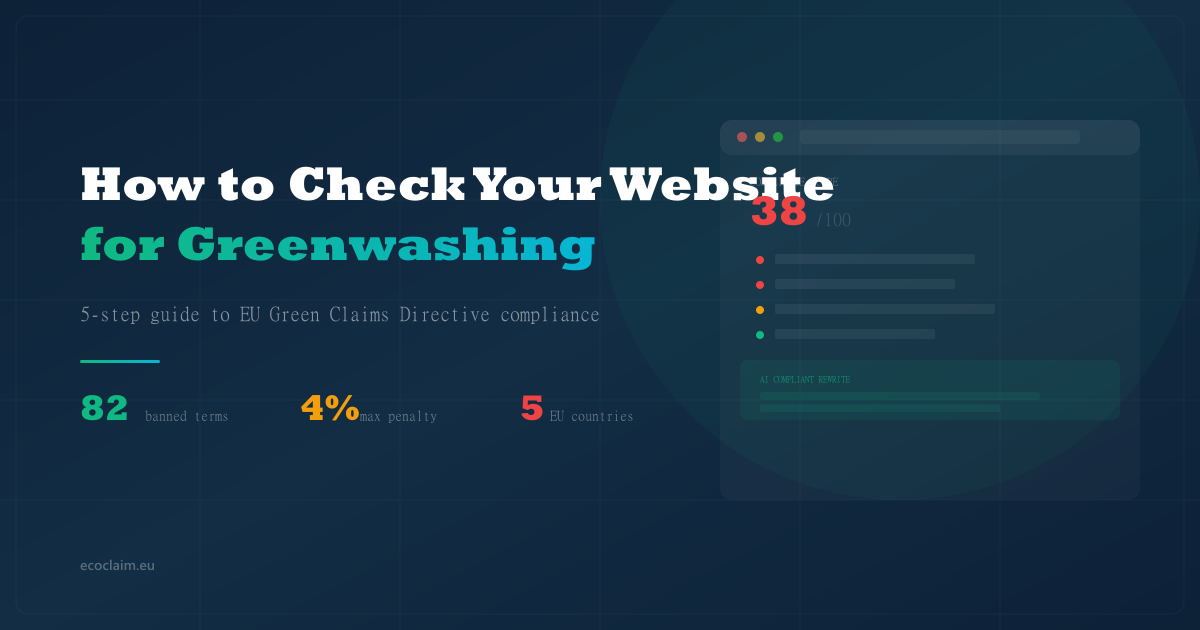
On September 27, 2026, the EU Empowering Consumers Directive (2024/825) takes effect across all 27 member states. If your e-commerce store uses terms like "eco-friendly," "sustainable," or "carbon neutral" without recognized certification, you face fines of up to 4% of annual turnover — per country. Germany's Federal Court of Justice already set precedent with its klimaneutral ruling in June 2024. France banned carbon-neutral claims in January 2023. This is not theoretical — it is enforcement-ready law.
The directive has applied since 27 September 2026. This article was written before that date: where it says 'before 27 September', read 'now'. Everything it tells you to check and fix still applies.
Most store owners don't realize their product pages contain greenwashing. The violations are often inherited from suppliers, copied from competitor listings, or written years ago when "eco-friendly" was acceptable marketing language. This guide shows you exactly how to find and fix every violation on your website — in five steps.
What Counts as Greenwashing Under EU Law
The Directive targets nine categories of misleading environmental claims. The most commonly violated are generic claims ("eco-friendly," "green," "sustainable"), offset-based carbon neutrality claims, self-created sustainability badges, and future performance promises without verifiable roadmaps. The full list includes 82 restricted terms that cannot appear in marketing without specific, verifiable substantiation.
The Directive covers every consumer-facing surface: product descriptions, homepage banners, checkout pages, packaging text, social media ads, and email marketing. If a claim is visible to an EU consumer, it is in scope.
How to Check Your Website for Greenwashing: 5 Steps

Step 1 — Run an Automated Greenwashing Scan
The fastest way to find violations is to run your store URL through an automated scanner that checks every page against the Directive's rules. A good scanner will crawl your entire site, flag specific claims by severity (critical, warning, compliant), reference the exact legal basis for each flag, and suggest compliant rewrites.
Scan Your Store in 60 Seconds
Paste your URL and get a compliance score, flagged claims, penalty estimates, and AI-generated compliant rewrites. No signup required.
Run Free Scan →Step 2 — Review Every Environmental Claim
Go through each flagged claim from your scan results. For every claim, ask: Is this backed by a recognized certification (EU Ecolabel, FSC, GOTS)? Does it include specific, quantified metrics? Is the evidence verifiable by a consumer? If the answer to any of these is no, the claim likely violates the Directive.
- "Eco-friendly" without certification → Banned under Annex I, point 2
- "Carbon neutral" via offsets → Banned under Annex I, point 4a
- "Sustainable collection" without specifics → Banned under Article 2(o)
- Self-created green badge → Banned under Annex I, point 2a
- "Will be net zero by 2030" without roadmap → Banned under Annex I, point 4

Step 3 — Check Images and Visual Claims
Greenwashing is not limited to text. The Directive also covers visual elements: green color schemes suggesting environmental friendliness, nature imagery on non-natural products, self-made eco-badges, and misleading packaging photos. An image compliance check can flag visual greenwashing that text scanners miss.
Step 4 — Verify Certifications and Labels
If your products carry certifications (EU Ecolabel, FSC, GOTS, OEKO-TEX, B Corp), verify that the certification numbers are displayed, the certifications are current (not expired), and the scope matches your claim. Displaying an expired FSC certification or claiming "certified organic" when only one ingredient qualifies is a violation under the Directive.
Step 5 — Check Country-Specific Rules
Enforcement varies significantly by EU member state. Germany published its implementing UWG amendment on 19 February 2026; from 27 September 2026 it is enforced mainly by competitors and associations through warning letters and court injunctions (how a greenwashing Abmahnung works). France banned all carbon-neutral claims since January 2023 — the strictest rule in the EU. The Netherlands fined KLM for misleading "Fly Responsibly" claims. Spain and Italy have their own enforcement bodies and case law.
Each country can impose penalties independently. A store selling into Germany, France, and the Netherlands faces three separate enforcement regimes. Country-specific guides help you understand the rules that apply to your markets.
Common Greenwashing Red Flags on Websites
After scanning thousands of e-commerce stores, these are the most frequent violations we detect:
- Vague claims on collection pages ("our sustainable range", "eco collection") — present on 73% of flagged stores
- Carbon-neutral claims based on offset partnerships — explicitly banned by the Directive
- Self-created green badges or "certified sustainable" labels without third-party verification
- Comparative claims without methodology ("greener than conventional", "lowest impact")
- Future promises without published, verifiable roadmaps ("net zero by 2030")
- Supplier-inherited claims that were never verified ("100% organic cotton" when only the outer layer qualifies)
What to Do If Your Website Has Greenwashing
Finding violations is the first step. Fixing them is straightforward. For each flagged claim, you have three options: remove the claim entirely, qualify it with specific evidence and certification references, or rewrite it using compliant language. The third option is usually best — it preserves your marketing impact while meeting legal requirements.
For example, "Our products are eco-friendly" becomes "Made with GOTS-certified organic cotton (certificate #OC-12345), using 91% less water than conventional farming (SGS-verified 2025 audit)." The claim is stronger, more credible, and fully compliant.
Once the scan has shown where the claims are, our EmpCo checklist for online shops is the order to work through them in.
Get Compliant Rewrites for Every Claim
EcoClaim's scanner flags every violation and generates AI-powered compliant rewrites you can copy-paste directly into your product pages.
Scan My Store Free →Curious what a finished scan output actually looks like? See a sample EcoClaim scan report for a non-compliant store — flagged claims, AI-rewrite suggestions, and country-specific risk all in one view.
Frequently Asked Questions
Sources
- EU Directive 2024/825 — Empowering Consumers for the Green Transition
- BGH Judgment I ZR 98/23 — Klimaneutral ruling (June 2024)
- French Decree No. 2022-539 — Carbon neutrality claims regulation
- ACM Guidelines on Sustainability Claims — Netherlands
- European Parliament — New law banning greenwashing (January 2024)
FAQ
Is there a free tool to check my website for greenwashing?
Yes. EcoClaim offers a free website scanner that checks every page against 82 banned terms under the EU Green Claims Directive (2024/825). No signup required — paste your URL and get results in 60 seconds.
When does the EU greenwashing law take effect?
EU Member States must enforce the Empowering Consumers Directive from September 27, 2026. However, German courts already apply the existing rules on misleading advertising to green claims (Federal Court of Justice, June 2024), and France banned carbon-neutral claims in January 2023.
What are the penalties for greenwashing in the EU?
Fines of up to 4% of annual turnover per country. Germany enforces mainly through court injunctions, backed by penalties of up to €250,000 per breach. France up to €100,000 or 80% of advertising spend. Each EU country enforces independently.
Can I still say 'sustainable' on my website?
Not without qualification. Generic terms like 'sustainable', 'eco-friendly', and 'green' are banned unless accompanied by specific, verifiable evidence and recognized certification on the same medium.
Free account
Keep your compliance work in one place
Scans you run while signed out disappear when you close the tab.
- Save every scan and come back to it later
- See whether your score improves after you fix things
- Store certificates against the claims they prove