Why a ChatGPT Prompt Won't Make Your Product Texts EmpCo-Compliant

Something interesting shows up in search data. People are typing whole LLM prompts into Google — instructions like "you are a German compliance checker for product texts, check HTML for legal risks: superlatives without evidence, greenwashing without a source, health claims without a standard." Not a question. A prompt. They are trying to build a compliance checker out of a chat window before the EmpCo / ECGT deadline on 27 September 2026.
The instinct is sound. You have a few thousand product descriptions, a deadline, and no budget for a law firm. An LLM reads text well and is genuinely good at spotting an unsupported superlative. So why does this approach fall apart in practice?
What the prompt gets right
Give credit where it is due. The prompts people are writing name the right risk categories: vague environmental claims, superlatives with no evidence, health or protection promises with no standard behind them. That is a decent working model of what the directive targets, and a general-purpose model will catch the obvious offenders — a "100% climate-neutral" on a product page is not hard to spot.
If your goal is a rough first impression of one page, a prompt will give you that. The problem starts the moment you need the result to hold up.
Five things a prompt cannot do
1. It gives you a different answer every time
Run the same product description through the same prompt three times and you will get three overlapping but different lists. That is normal behaviour for a generative model, and it is fatal for compliance work. If a colleague re-runs your audit and gets a different result, neither of you can say which one was right — and you cannot show a regulator a process that does not repeat. A rule set is deterministic by construction: the same text trips the same rule every time, because the rule is a rule and not a prediction.
2. It cannot reliably cite the rule it applied
Ask a model why a phrase is a problem and it will produce a legal-sounding citation. Sometimes it is correct. Sometimes it cites an article number that does not exist, or attributes a prohibition to the wrong instrument — mixing up the EmpCo Directive with the separate Green Claims Directive proposal that was withdrawn in June 2025. A citation you have to verify by hand is not saving you the work you hired it to do.
A wrong flag costs you an afternoon. A wrong legal basis costs you a rewrite you did not need, or worse, false confidence in a claim that was actually prohibited. If you use an LLM for this, treat every legal reference it produces as unverified until you have checked it against the directive text yourself.
3. It never sees your images
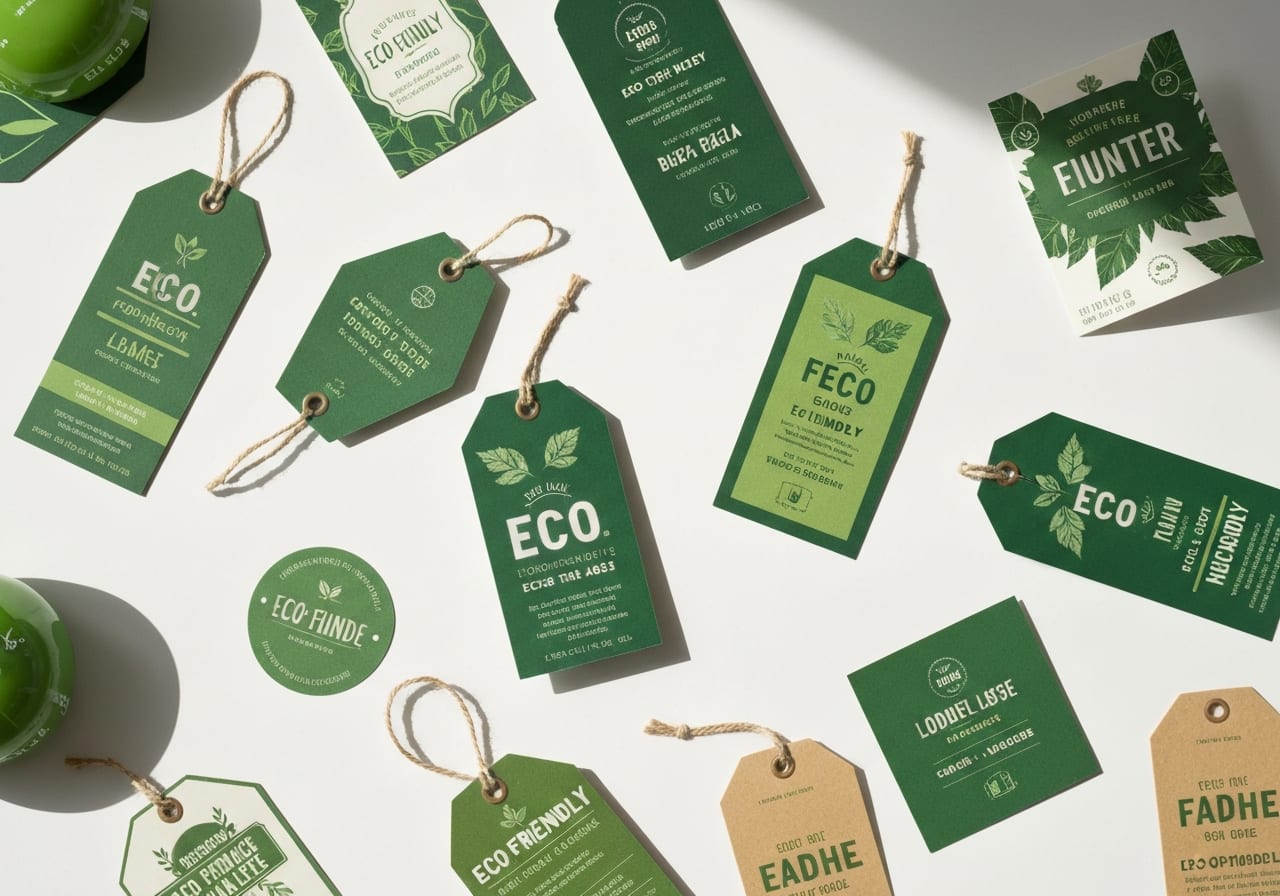
This is the biggest blind spot and the easiest to overlook. Paste your HTML into a chat window and the model reads your text. It does not read the claim printed inside your hero banner, the green leaf badge on your packaging shot, or the certification logo in your footer graphic. Across the sites we have scanned, misleading visual imagery and misuse of certification marks are two of the most common findings — and a text-only prompt cannot see either of them.
4. It cannot tell a substantiated claim from an unsubstantiated one
Under the directive most environmental claims are not banned outright — they are conditional. "Organic cotton" is fine if you hold the certificate and it covers that product. It is a violation if you do not. The words on the page are identical in both cases. A model looking only at your copy has no way to know which situation you are in, so it either flags every legitimate claim you can actually prove, or waves through claims you cannot. Neither is useful. You need the evidence linked to the claim, not just an opinion about the wording.
5. It leaves no dated record

If a consumer-protection authority or a competitor challenges a claim, the useful thing is not a chat transcript. It is a dated report showing what your site said on a given day, which rule each claim was measured against, and what you changed. A chat window produces none of that, and the conversation is gone the moment you close the tab.
The same sentence, two ways
Take a real-looking line: "Our climate-neutral bamboo bottle — the most sustainable choice, made from all-natural materials." A typical prompt returns something like "this contains vague sustainability claims, consider revising." True, but not actionable.
A rule-based check separates it into three distinct problems with three different fixes. "Climate-neutral" based on offsetting is a per-se prohibition under Annex I — no evidence rescues it, the phrase has to go. "Most sustainable" is a comparative superlative that needs substantiation against a defined comparison set. "All-natural" is a generic environmental claim requiring recognised excellent environmental performance. Three findings, three legal bases, three specific rewrites — instead of one paragraph of advice.
Take one product description and run it through your prompt three times in a fresh chat each time. Count the findings. If the three lists do not match, you have just measured the reproducibility problem on your own copy — and that is the number to keep in mind before trusting the output.
Check a product text against the actual rule set
Paste a product description, ad copy or packaging text and see which specific rule each phrase trips, with the article it comes from and a compliant rewrite. Free, no account needed, results in seconds.
Open the free copy checker →What to do instead
- Start from the term list, not from a prompt. There are 82 terms that are banned or restricted outright. Searching your catalogue for those is a finite, checkable job — see the full banned-terms reference.
- Check images as well as text. Anything printed inside a graphic counts as a claim. If your process only reads HTML, you are auditing half your storefront.
- Collect your certificates before you rewrite. Half of what looks like a violation is a legitimate claim you can prove. Find the evidence first, then rewrite only what is genuinely unsupported.
- Keep a dated record of each pass. The value of an audit is being able to show it later.
- Use an LLM where it is strong — drafting the compliant replacement wording once you know which rule you are fixing. That is a writing task, and models are good at writing.
None of this means AI has no place in compliance work. It means the model should be applying a fixed rule set rather than improvising one, reading your images as well as your text, and writing its findings into something you can keep. That is a different tool from a chat window — not a smarter prompt.
Sources
- EcoClaim — Banned & Restricted Green Claims (full reference)
- EU Directive 2024/825 — Empowering Consumers for the Green Transition
- Directive 2005/29/EC — Unfair Commercial Practices Directive (consolidated)
- Gorrissen Federspiel — European Commission Withdraws the Green Claims Directive Proposal
- EcoClaim — Greenwashing Statistics 2026 (live benchmarks)
FAQ
Can I just use ChatGPT to check my product descriptions for greenwashing?
For a rough first impression of a single page, yes. For an audit you intend to rely on, no — the same text produces different findings on different runs, legal citations are frequently invented, and a text-only prompt cannot see claims printed inside your images. Use it to draft compliant replacement wording once you know which rule you are fixing.
Why does reproducibility matter for a compliance check?
Because an audit only has value if it repeats. If two people run the same check and get different results, neither can say which was correct, and you cannot demonstrate a consistent process if a claim is later challenged. A fixed rule set trips the same rule on the same text every time.
What does an LLM prompt miss that a scanner catches?
Claims printed inside images and certification logos, which text-only prompts never see; the link between a claim and the certificate that substantiates it; the specific article each finding maps to; and a dated record of what your site said on a given day.
Is 'climate-neutral' banned outright under the EmpCo Directive?
A neutrality claim based on carbon offsetting is a per-se prohibited practice under Annex I of the amended Unfair Commercial Practices Directive. Unlike most environmental claims it cannot be rescued with substantiation — the wording itself has to change.
When does this actually apply?
The EmpCo / ECGT Directive (2024/825) applies from 27 September 2026. The transposition deadline for member states passed in March 2026, so national implementing rules are already in force in several countries.
Free account
Keep your compliance work in one place
Scans you run while signed out disappear when you close the tab.
- Save every scan and come back to it later
- See whether your score improves after you fix things
- Store certificates against the claims they prove